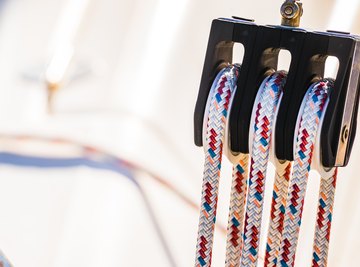

A pulley system makes it easier to lift an object than lifting the weight by hand. A single pulley essentially changes the direction of the pull or force applied. When a person uses two or more pulleys in a system, then the system also multiplies the force applied in addition to changing direction. With one fixed and one movable pulley in a system, it essentially doubles the weight of the load you could lift without help from another person based upon which heavy objects you can lift.
The Pulley: A Simple Machine
Simple machines are mechanical tools that help to redirect or decrease the amount of force needed to move heavy loads a certain distance. Inclined planes, wedges, levers, screws, and pulleys are all types of simple machines.
Simple machines work to reduce the force required to move an object, but the amount of work done will always remain the same. Work is a value that describes how a force (F) is exerted over a certain distance (d):
As less force is needed to move a heavy weight, the distance required to move it will actually increase based on the simple machine. So a simple pulley system that cuts the force in half, will double the distance of rope that will be used, resulting in equivalent work.
A pulley has two equal arms and operates on a fulcrum like the lever does, though it is a wheel with rimmed edges on an axle threaded with a rope – instead of a stationary balancing point.
How Pulleys Work: Mechanical Advantage
Simple machines like the pulley give you a mechanical advantage, essentially making you stronger than you are in real life. Physicists quantify the work the system does by calculating mechanical advantage in Newtons, named after Sir Issac Newton, the originator of the laws of motion. It takes 1 newton to move 1 kilogram of mass at the rate of 1 meter per second squared in the direction of the applied force. To calculate the mechanical advantage of a pulley, divide the output force by the input force; in other words divide the force exerted on the object by the force exerted on the end of the rope as you use the pulley.
One Fixed, One Movable Pulley
While using only one pulley requires you to use the same force it would take to lift a load by hand, a fixed pulley combined in a system with a movable pulley, essentially doubles the force applied to lift or move the object. For example, if you have an object that weighs 100 N, all it would take to lift the object in this pulley system are 50 newtons of force applied. The MA of this type of system equals two.
A System of Pulleys
While a single pulley allows you to move a load with half the force required, adding a second pulley to form a system of pulleys increases the mechanical advantage by the number of pulleys and the lengths of rope that support the load. The number of rope strands that support the load in a multiple pulley system basically correspond to the mechanical advantage of the system. For example, if you have two fixed and two movable pulleys, four lengths of the rope support the load with a mechanical advantage of four. A 100 N load would require 25 newtons of force applied to lift it.
Other types of pulleys, like compound pulley systems and block and tackle systems are more complex combinations of pulleys that allow for a greater amplification of pulling force through adding additional pulleys and components to reach a better mechanical advantage. Different types of pulleys might be tailored for specific use cases, especially if the direction of the force applied to an object might need to be modified.
References
About the Author
As a journalist and editor for several years, Laurie Brenner has covered many topics in her writings, but science is one of her first loves. Her stint as Manager of the California State Mining and Mineral Museum in California's gold country served to deepen her interest in science which she now fulfills by writing for online science websites. Brenner is also a published sci-fi author. She graduated from San Diego's Coleman College in 1972.