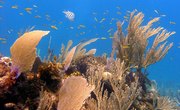
How Do Coral Reefs Depend on Photosynthesis?

How Do Coral Reefs Depend on Photosynthesis? thumbnail
A coral reef depends on sunlight.

Coral reefs, those beautiful structures found in shallow tropical oceans, play an important role in their ecosystems. Besides being home for the coral itself, these reefs provide a protective habitat for countless sea organisms. Among these organisms are the reef-building corals themselves and zooxanthellae, a type of photosynthetic algae. These two organisms depend on each other for their survival.

  1. Coral

    • Corals are animals that join to live as a colony. One reef is actually composed of hundreds of thousands of individual coral organisms called polyps. A coral polyp consists of a stomach and a mouth surrounded by tentacles that catch food and dispel wastes. Corals also secrete calcium carbonate, which forms the calyx, the hard skeleton that a coral sits in. The individual polyps of a colony are connected by a thin band of living tissue and the hard stony shells join to create the reef.

    The Role of Zooxanthellae

    • Each coral polyp is the host organism for photosynthetic algae called zooxanthellae. Photosynthetic means that the algae require sunlight to produce food, so coral reefs are found in shallow, clear water. However, the algae also require water and carbon dioxide, which are provided by the coral as by-products of its cellular respiration. In turn, the algae produce glucose (sugar), glycerol (fat), amino acids (used in making protein) and oxygen, all of which are needed by the coral to make its food.

    Mutual Benefits

    • Both the coral and the zooxanthellae need this mutually beneficial relationship to survive. Coral provides protection, water and carbon dioxide for the algae, while the algae give the coral the nutrients it needs to produce food. In fact, the coral is so dependent on the algae that it acts in many ways like a plant, such as living where there is sufficient sunlight. Coral colonies that become stressed due to environmental conditions may expel, or blow, all the zooxanthellae, a process known as coral bleaching. When this happens, the coral soon dies.

    Reef Building

    • A coral polyp secretes calcium carbonate, formed with the help of the zooxanthellae, to make the hard stony calyx. This acts as an external skeleton, providing protection from predators. From time to time, a polyp raises itself up off the floor of its calyx and secretes a new floor, leaving a small space between the new and old base. Over thousands of years, a colony of coral polyps secretes enough calcium carbonate to build a reef.

    Threats to Coral Reefs

    • Coral reefs face a number of dangers that can damage, or even kill, whole colonies. Greatest among these is anything that blocks the sunlight essential for photosynthesis. Runoff from agricultural areas may contain fertilizers high in the nitrates that certain algae types need, creating a large colony of algae that compacts together as it floats on the water's surface. This mass, known as an algae bloom, can block sunlight to a coral reef under the surface, depriving the zooxanthellae of the means for photosynthesis. Reefs are also damaged or smothered by garbage, careless fishing practices, violent weather and prolonged low-water levels.

Related Searches:

References

  • Photo Credit coral reef 21 image by Christian Schoettler from Fotolia.com

Comments

You May Also Like

  • Benefit of Photosynthesis

    Photosynthesis is vital to the existence of life on earth. It is the process by which plants produce chemical or organic life...

  • Plants That Live in the Coral Reefs

    Coral reef plants live in warm coastal waters that receive an abundance of sunlight. These tropical plants are an important part of...

  • How Do Nutrients Cycle in Coral Reefs?

    Corals are marine structures composed of millions of small organisms called polyps. According to the National Oceanic and Atmospheric Association, polyps secrete...

  • 10 Facts on Photosynthesis

    10 Facts on Photosynthesis. To most people, plants are the most obvious organisms using photosynthesis. The photosynthesis process is the ultimate source...

  • What Do Coral Reefs Need to Survive?

    Coral reefs are home to more than 1 million species of aquatic wildlife, provide billions of dollars to various industries and are...

  • How Long Do Corals Live?

    Although corals look like giant sea plants or rocks, they are actually made up of millions of tiny animals. Coral reefs are...

  • Coral Reefs & Algae

    Coral reefs contain many different types of algae, most of which are beneficial and even necessary to life in the reef. If...

  • Inhabitants of Coral Reefs

    Inhabitants of Coral Reefs. Coral reefs are sometimes called the rainforest of the ocean. The coral reef and the diverse numbers of...

  • Where Are Photosynthetic Pigments Found in Green Plants?

    Whether directly or indirectly, nearly all life on Earth relies on solar energy converted to chemical energy through a process called photosynthesis....

  • How Do Plants, Animals & Bacteria Depend on Each Other?

    A complex web of interactions link plants, animals and bacteria in a community together. While some types of relationships are detrimental to...

  • About Mushroom Coral

    Mushroom coral can add some interesting color and texture to a marine aquarium. It can be kept in an aquarium that houses...

  • How Do Coral Reefs Build Up?

    Surfers and scuba divers often center their activities near ancient formations in the ocean called coral reefs. These structures are the only...

  • What Is a Fan Coral?

    There are over 500 different species of Gorgonians, varying in size and color. Some species can grow as tall as several feet,...

  • How to Protect Coral Reefs

    Coral reefs help prevent erosion of beaches, provide breeding and feeding grounds for marine life, control carbon dioxide in the water and...

  • Importance of Light in Photosynthesis

    Photosynthesis is a compound word formed from the prefix photo for light and the suffix synthesis for putting things together. As its...

  • How Do We Depend on Photosynthesis?

    Photosynthesis is a chemical process that plants perform in order to get the energy that they need to survive and grow. The...

  • Why Coral Reefs Come in Many Colors

    Coral reefs are large underwater structures made up of thousands of coral lifeforms. Their wide range of colors are caused by a...

  • 5 General Facts of Photosynthesis

    5 General Facts of Photosynthesis. Photosynthesis is the act of organisms converting carbon dioxide into organic compounds in order to nourish themselves....

Related Ads

Featured