
How Is Diesel Gas Made?

How Is Diesel Gas Made? thumbnail
An increasing variety of diesel fuels are becoming available.

Petrodiesel is made by a heating and cooling process called fractional distillation. Biodiesel manufacturers use vegetable oil or animal fats and a chemical reaction called transesterification. Synthetic diesel production (also known as BML or Biomass to Liquid) utilizes dried and gasified garbage, sewage-sludge wood, straw, corn, and hemp and a set of chemical reactions known as the Fischer-Tropsch process. To produce gas-to-liquid diesel, manufacturers convert gaseous hydrocarbons into longer-chain hydrocarbons such as diesel fuel.

  1. Key Concepts

    • Hydrocarbons are the most important energy source on earth. When burned, they release significant amounts of energy. Crude oil is the predominant source of hydrocarbons, which are the essential components of diesel. Esters are compounds usually formed by the reaction between an acid and an alcohol with elimination of water. Transesterification is a chemical reaction in which one ester is converted into another. Transesterification is essential to the production of biodiesel.

    Petrodiesel

    • After alternatives to traditional, petroleum-derived diesel became more common, industry experts referred to diesel as petrodiesel in order to avoid confusion. Petrodiesel is made by a process known as fractional distillation. Fraction distillation is the separation of a compound liquid (crude oil in this case) at varying degrees of heat so that components separate. Crude oil contains various types of hydrocarbons. Different hydrocarbons have different boiling points. To separate out the diesel, manufacturers heat crude oil at a temperature of 482 degrees to 660 degrees Fahrenheit at normal atmospheric pressure. The resulting fumes are collected and allowed to cool into a liquid state which we call diesel fuel.

      There are different grades of diesel fuel, depending on sulfur content. According to DieselNet: "Since the 1990s, fuel quality has been increasingly more regulated by the US EPA under the authority of the Clean Air Act. In the context of the increasingly more stringent diesel emission standards, the most important fuel property regulated by the EPA became the sulfur content."

    Biodiesel

    • There are three ways to make biodiesel: through catalyzed transesterification of the oil; through direct acid catalyzed transesterification of the oil; or through conversion of the oil to its fatty acids and then to biodiesel. The basic process is essentially the same for the three methods: an alcohol and a base are mixed, producing a chemical reaction. Later, the manufacturer separates the resulting glycerin and biodiesel、and then removes the alcohol. Using various chemicals, the manufacturer then neutralizes the glycerin and washes the biodiesel with a methyl ester. Some people mix biodiesel and petrodiesel to compensate for the fact that biodiesel tends to solidify into a gel in cold temperatures.

    Synthetic Diesel

    • Synthetic diesel (also known as BML or Biomass to Liquid) is made from dried and gasified garbage, sewage-sludge wood, straw, corn, and hemp. The resulting gas is then purified in the Fischer-Tropsch process, a set of chemical reactions that converts mixtures of carbon monoxide and hydrogen (in this case, the gas produced from the garbage, straw, corn, etc.,) into liquid hydrocarbons. The resulting diesel is low in sulfur, making it an attractive alternative to petrodiesel.

    Gas to Liquid Diesel

    • The Fischer-Tropsch process is also the key to producing diesel from hydrocarbon-rich gases such as methane. The methane is partially oxidized, and the resulting excess carbon dioxide and water are removed. The remaining liquid is then reacted over a cobalt or iron catalyst to produce longer chains of hydrocarbons, out of which diesel can be removed by fractional distillation.

Related Searches:

References

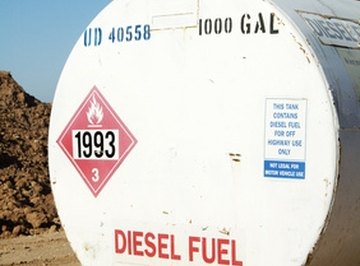
  • Photo Credit old diesel tank image by charles taylor from Fotolia.com

Comments

You May Also Like

  • How Is CO2 Gas Made?

    Carbon dioxide, or CO2, makes up about 0.036 percent of the earth's atmosphere. Many atmospheric scientists maintain that carbon dioxide contributes to...

  • How Cars Use Biomass

    Biomass relates to organic material that can be used to provide energy, such as wood, sugar cane and other waste organic material....

  • How to Make Black Diesel Fuel

    Black diesel fuel is not an easy find or an easy recipe to make. But if you can find the right recipe...

  • How Is Diesel Fuel Made From Crude Oil?

    Diesel fuel is one of many substances refined from crude oil. Diesel is widely used in transportation, where it fuels locomotives, heavy...

  • Chemicals Used to Make Biodiesel

    Comments. You May Also Like. How to Modify a Car Engine to Use Biofuel. A biofuel is a fuel made from plant...

  • About Gas Fire Pits

    Shaped as Grecian urns, end tables or campfires, gas fire pits can add light, beauty and warmth to any garden, patio or...

  • Diesel Trucks Made With Two Fuel Tanks

    Most over-the-road (long-haul) trucks are equipped with two fuel tanks, with one located on each side of the cab. Dual fuel tanks...

  • How to Get Better Gas Mileage From a Duramax Diesel

    With the uncertainty of the cost of fuel many Duramax diesel owners want to look for ways to improve mileage on their...

  • How to Clean a Diesel Tractor Gas Tank

    Maintaining a diesel tractor is crucial in order to have it last for a long time. The engine in a diesel tractor...

  • How Is Motor Oil Made?

    Motor oil is a special type of oil designed to be used for high-powered engines that are installed in vehicles. The oil...

  • Biodiesel Production Companies

    Biodiesel Production Companies. The National Biodiesel Board (NBB) is a national association representing the biodiesel industry in the U.S. As of October...

  • Biofuel B100 Test Methods

    Biofuel B100 is pure biodiesel, a renewable fuel produced from sources such as vegetable oil or animal fat. Biofuel B100 consists of...

  • How Do Cars Run on Chemical Reactions?

    Cars provide us with a means of travelling great distances at great speeds with very little work. But you can't get something...

  • How Is Urea Used in Diesel Engines?

    Although diesel engines were once (rightly) considered little more than industrial manufacturers of soot and smoke, modern advances in emissions and control...

  • Economics of the Fischer-Tropsch Process

    The Fischer-Tropsch Process is a process of turning natural gases into hydrocarbons that can be used to power vehicles and serve as...

  • How to Make Leaded Gas

    Leaded gas is gasoline to which a compound of lead has been added. Commonly tetra-ethyl lead, this compound was added to reduce...

  • Gas vs. Diesel Mileage

    Gas versus diesel: is there a difference in output and mileage efficiency? Many drivers would like to think so. However, the truth...

  • What Makes a Diesel Smoke?

    When operating properly, no smoke should be seen coming from the tailpipe of a diesel engine. However, if smoke is visible, there...

  • How to Troubleshoot Bio-diesel Production

    Bio-diesel production involves a relatively straightforward series of chemical reactions, but many things can still go wrong in a home production setting...

Related Ads

Featured