Gray Bat Facts

Gray Bat Facts thumbnail
Gray bats live only in caves.

Gray bats (Myotis grisescens) are some of the largest members of their scientific family---the mouse-eared bats. Highly gregarious creatures, they join together in large colonies for their winter hibernation. Gray bats play an important role in the maintenance of a healthy ecosystem. A single bat can eat hundreds of insects in one night (see Resources).

  1. Description

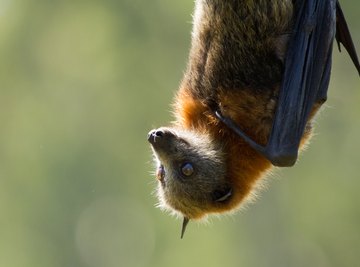
    • Gray bats are about 4 inches in length and weigh only 0.2 to 0.3 ounces. The gray bat is the only one of the mouse-eared bats to have its wing membrane attached at the ankle rather than the toe. It is also distinguished as the only bat with uniform back hair color from top to bottom. Following a July or August molt, gray bats have dark gray fur, which then often lightens to a chestnut brown.

    Habitat

    • Unlike some other bats, which may inhabit hollow trees or buildings, gray bats live only in caves. Because they do not migrate to warmer areas for winter, gray bats require a cave with a temperature between 42 and 52 degrees for winter hibernation, according to the website "All About Bats." In summer, gray bats seek out a cave near a source of water, such as a river, stream, pond or reservoir, so they can find food.

    Range

    • Gray bats seek out areas with limestone caves where they make their colonies; the caves are found mainly in the central and eastern U.S. Their range includes Kentucky, Missouri, Alabama, northern Arkansas and Tennessee. Lesser numbers can be found in parts of Illinois, Indiana, Mississippi, Virginia, Florida, Georgia, Kansas, Oklahoma and possibly North Carolina.

    Reproduction and Young

    • As female gray bats prepare to give birth in the summer, they congregate in a separate cave while the males gather nearby. The females give birth to single young in late May or early June. In late July, the males join the females in the maternity colony. Young bats make their first flight approximately one month after birth, according the the website "Animal Info."

    Feeding Habits

    • Like others of the Myotis species, gray bats roost during the day and hunt at night, mainly for insects. They alternate periods of foraging with periods of rest, as they hang in their cave and digest. Bat colonies have a home range during the summer, traveling miles if necessary from their cave to a feeding area. They may move among multiple caves during the summer.

    Endangered Status

    • The gray bat was included on the U.S. List of Endangered and Threatened Wildlife and Plants in 1976. Because they live in large numbers in only a small number of caves, gray bats are very vulnerable to disturbance, especially when hibernating or caring for young. Gray bats are harmed by pesticides used in agriculture when their diet is poisoned by chemical runoff (see Resources). They have also endured habitat loss due to flooding and cave commercialization, according to the U.S. Fish and Wildlife Service.

Related Searches:

References

Resources

  • Photo Credit cave II image by morsted from Fotolia.com

Comments

You May Also Like

  • Gray Bat Endangered Species Facts

    The gray bat, or Myotis grisescens, is native to the United States and most commonly lives in the southeastern portion of the...

  • Gray Bat Habitat

    The gray bat (Myotis grisescens) is listed as an endangered species by the U.S. Fish and Wildlife Service. Part of the reason...

  • Regulations on the Removal of Bats

    Regulations on the Removal of Bats. Bats are probably one of the most misunderstood of animal species. However, bats are beneficial to...

  • Indiana Bat Facts

    Indiana bats are rarely seen by humans. A close relation to the little brown bat the Indiana bat is similar in appearance...

  • Bumblebee Bat Facts

    Bumblebee bats (Craseonycteris thonglongyai), also referred to as Kitti's hog nosed bat, are found in remote sections of Thailand and Myanmar. These...

  • Bat Facts for Kids

    Bats are fascinating animals that seem to invoke both fear and wonder alike. They have the distinction of being the only mammal...

  • Kindergarten Bat Activities

    Kindergarten children can be introduced to the topic of bats for Halloween, simple science learning and also through picture books. Bats sleep...

  • Facts About the Hoary Bat

    Hoary bats are more widespread than any other bats in the Americas. They are found in every state except Alaska, and from...

  • Where Do Vampire Bats Live?

    Vampire bats live only in Central and South America, where three different kinds of vampire bats can be found. Learn about the...

  • What Is the Food Web for a Gray Squirrel?

    Gray squirrels are one of the most familiar creatures in North America, commonly seen even in major urban areas. Most of the...

  • How to Make a Kid's Bat Costume

    As flying nocturnal creatures, bats have long been associated with darkness and intrigue. Bats have been canonized in literature and film, from...

  • Vampire Bat Facts for Kids

    Watch out for a vampire -- bat, that is. While the blood-drinking bats won't leave you drained, you can catch rabies from...

  • Bat-Eared Fox Facts

    The bat-eared fox, or Otocyon megalotis, is a species of fox native to the eastern and southern regions of Africa. It is...

  • Cave Bat Facts

    Whether they are hiding in attics or inspiring Batman films, cave bats are some of the strangest animals in nature. They are...

  • Habitat of Gray Seals

    Gray seals, Halichoerus grypus, are mammals belonging to the order Pinnipedia. The gray seal's scientific name translates to "hook-nosed sea pig." Gray...

  • Mexican Wolf Facts for Kids

    The Mexican wolf is a smaller relative of the gray wolf that lives in the United States. It is the most endangered...

Related Ads

Featured