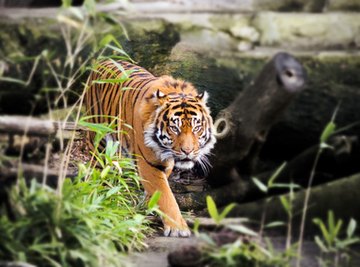
Food webs demonstrate how organisms interact. The three roles demonstrated by all animals, plants, bacteria and other living organisms are those of producers, consumers and decomposers. Producers include plants and algae. Consumers are further broken down into primary, secondary and tertiary consumers, as well as carnivores, herbivores and omnivores. Decomposers consist of those organisms that consume dead matter.
Producers
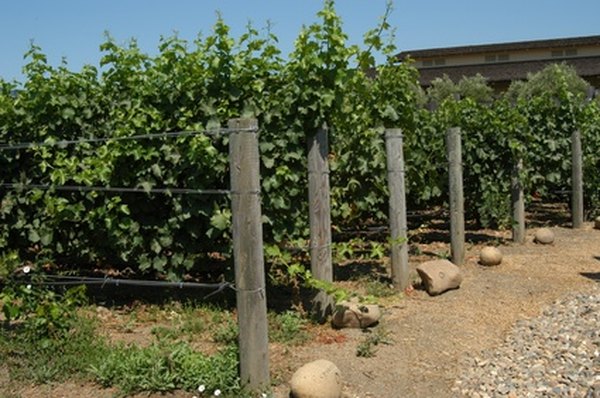
Producers include plants and other organisms that convert environmental constants or organismal byproducts, such as light, oxygen, carbon dioxide and water, into energy in the form of sugar. The group of producers also contains some aquatic photosynthetic organisms. All the food chains that make up food webs begin with plant life. A typical food web path involving plants would be the following scenario: a grass plant develops into edible proportions, and a cow eats that plant, fueling itself to produce milk and carry out the activities of life. Note that not all plants are strictly producers. Some plants, such as the Venus Flytrap, consume other organisms.
Consumers
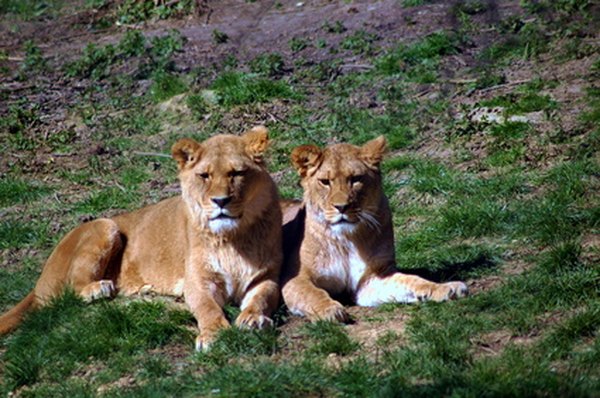
Consumers consist of carnivorous, herbivorous and omnivorous animals. Carnivores consume other animals as the major part of their diet. Herbivores, those animals that consume plants, are also known as primary consumers. Carnivores and the less picky omnivores eat herbivores for sustenance. Omnivores consume both plants and other animals. Food webs further break down carnivores into secondary and tertiary consumers: carnivores that consume herbivores and those that consume other carnivores, respectively. A single carnivorous species may exist as more than one type of consumer; for instance, a bear eating berries acts as a primary consumer, but a bear eating salmon acts as a tertiary consumer. An example of a food web involving consumers would be a tiger stalking, hunting and consuming an antelope that has spent its days grazing on grasses. The grass grows by photosynthesis, generating energy.
Decomposers
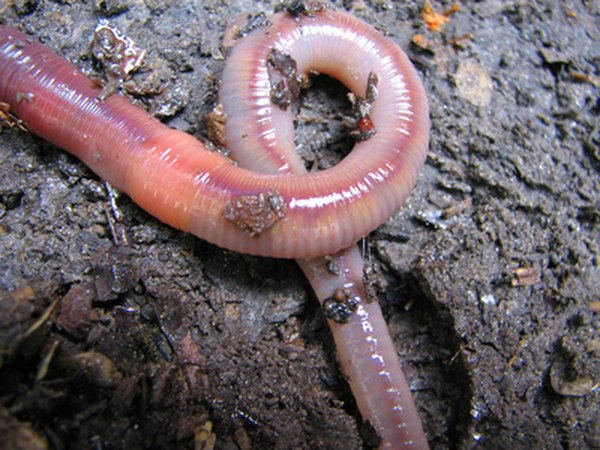
Decomposers include fungi, bacteria and some invertebrate organisms. Ninety-five percent of organisms on the planet fall into the group of invertebrates. Worms, sea sponges, insects, arachnids, and crustaceans are all examples of invertebrates. Although not all invertebrates are decomposers, many serve as nature's garbage disposals, assisting decaying matter to decompose further and helping to get rid of carcasses and keep the environment relatively clean. An example of a food web path involving decomposers would be a dead bird on the soft forest floor being promptly surrounded by worms, fungal spores, bacteria and insects. These organisms consume and break down the decaying flesh, converting it into useful organic byproducts.
References
About the Author
Judy Al-Ahmary has been writing professionally since 2008. She has written documentation as a computer technician, and she writes educational and health-related articles for eHow. Al-Ahmary holds a Bachelor of Science in environmental science from Saint Mary's University in Halifax, Nova Scotia, Canada.
Photo Credits
tiger image by Mat Hayward from Fotolia.com