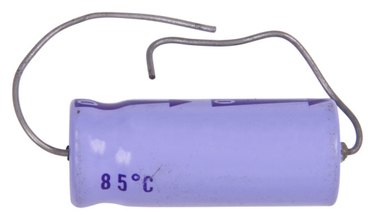
Capacitors are passive electronic components, meaning they do not require extra electricity to function, as transistors do. In a circuit, the function of a capacitor is to hold a voltage, or a "charge," for a specific amount of time. Different chemical processes and materials are used in capacitor construction, but all types of capacitors behave in the same manner.
Capacitor Operation
Video of the Day
All types of capacitors are constructed with an insulating layer that is sandwiched between two conductive plates. Electrical current causes the capacitor to build a voltage, which is called "charging." Because of the insulating layer between the two plates, the voltage is "held" in the capacitor. When current is removed, the voltage dissipates, or "discharges." The amount of time for charging and discharging depends on how much voltage a capacitor can hold.
Video of the Day
Capacitance
The amount of voltage/charge that a capacitor can hold is referred to as its capacitance. This is a value measured in Farads and is usually printed on the capacitor. The capacitance value also determines how long the capacitor takes to charge/discharge. That time factor is important because certain capacitors have to be matched to certain frequencies, or operating speeds, in a circuit.
Polarity
In certain types of capacitors, the two conductive plates are polarized. This means that one plate is positive and other is negative. The polarity is extremely important for circuit connections. If connected improperly, polarized capacitors may malfunction or explode. Both electrolytic and tantalum capacitors are polarized and markings are printed on the surface of the capacitors.
Electrolytic Capacitors
An electrolytic capacitor contains two conductive plates, an insulating layer, and an "electrolyte" liquid such as boric acid. Because of the chemical construction, one plate becomes the anode, or positive, and one plate becomes the cathode, or negative. The basic electrolytic capacitor is aluminum oxide and it looks like a cylinder with two legs. Electrolytics are efficient because they have high capacitance values for their size. Aluminum oxide electrolytic capacitors are widely used for smoothing out, or filtering, waves of voltage and current.
Tantalum Capacitors
A tantalum, or tantalum oxide, capacitor is actually a type of electrolytic capacitor. They are available in small SMD (surface-mount device) packaging and are polarized like aluminum oxide capacitors. However, tantalum oxide capacitors have a much higher capacitance value for their size. They are more expensive than aluminum oxide, but they are more reliable, more stable and they operate better at certain frequencies. Tantalum capacitors are often used as "decoupling" or "bypass" capacitors, which reduce electronic "noise" in digital circuits.