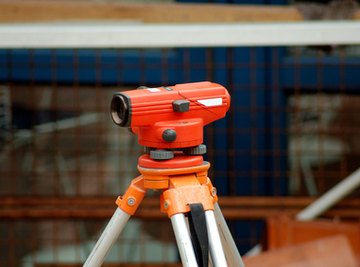

A laser distance meter works by use measuring the time it takes a pulse of laser light to be reflected off a target and returned to the sender. This is known as the "time of flight" principle, and the method is known either as “time of flight” or “pulse” measurement.
Operating Principle
A laser distance meter emits a pulse of laser at a target. The pulse then reflects off the target and back to the sending device (in this case, a laser distance meter). This "time of flight" principle is based on the fact that laser light travels at a fairly constant speed through the Earth’s atmosphere. Inside the meter, a simple computer quickly calculates the distance to target. This method of distance calculation is capable of measuring the distance from the Earth to the moon within a few centimeters. Laser distance meters may also be referred to as “range finders” or “laser range finders.”
Calculating Distance
The distance between the meter and target is given by D=ct/2, where c equals the speed of light and t equals the amount of time for the round trip between meter and target. Given the high speed at which the pulse travels and its focus, this rough calculation is very accurate over distances of feet or miles but loses accuracy over much closer or farther distances.
Why Lasers?
Lasers are focused, intense beams of light, usually of a single frequency. They are very useful for measuring distances because they travel at fairly constant rates through the atmosphere and travel much longer distances before divergence (the weakening and spreading out of a beam of light) reduces the efficacy of the meter. Laser light is also less likely to disperse like white light, which means that laser light can travel a much greater distance without losing intensity. Compared with ordinary white light, a laser pulse retains much of its original intensity when reflected off the target, which is very important when calculating distance to an object.
Considerations
The accuracy of a laser distance meter depends on the original pulse returning to the sending device. Even though laser beams are very narrow and have high energies, they are subject to the same atmospheric distortions that affect normal, white light. These atmospheric distortions may make it difficult to get an accurate reading of the distance of an object near greenery or over long distances of more than 1 kilometer in desert terrain. Also, different materials reflect light to greater or lesser degrees. A material that tends to absorb or scatter light (diffusion) reduces the likelihood the original laser pulse can be reflected back for calculation. In cases where the target has diffuse reflection, a laser distance meter using a “phase shift method” should be used.
Receiving Optics
To ensure reliability, laser distance meters employ some method to minimize background light. Too much background light can interfere with the measurement when the sensor mistakes some part of the background light for the reflected laser pulse, resulting in a false distance reading. For example, a laser distance meter designed for use in Antarctic conditions, where intense background light is expected, employs a combination of narrow bandwidth filters, split beam frequencies, and a very small iris to block out as much interference from background light as possible.
Applications
Laser distance meters and range finders have a wide variety of uses, from map making to sports. They can be used to create maps of the ocean floor or topography maps cleared of vegetation. They are used in the military to provide exact distance to targets for snipers or artillery, for reconnaissance and for engineering. Engineers and designers use laser distance meters to construct 3D models of objects. Archers, hunters and golfers all employ range finders to calculate distance to target.
References
About the Author
Curtis Seubert started writing professionally in 2008. He has taught writing at universities in the USA and in Japan. Since 2000 he has lived in Japan, teaching English, writing and playing bass. He holds a Master of Arts in English literature with an interdisciplinary emphasis in quantum mechanics.
Photo Credits
Laser Entfernungsmesser image by Otmar Smit from Fotolia.com