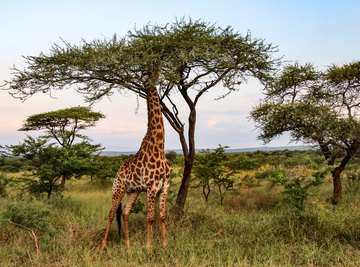

There’s no taller animal on Earth than the giraffe: A full-grown male, or bull, may stand 18 feet above the ground. These towering, knobby-legged browsers, found across a shrunken and fragmented range of sub-Saharan Africa, certainly rank among the most distinctive-looking of all mammals, but scientists aren’t entirely settled on the evolutionary purpose of some of the most conspicuous giraffe adaptations.
The Mammalian Skyscraper: The Giraffe’s Stretched-Out Neck
Both male and female giraffes boast long necks, which in large bulls may be upward of 8 feet long and weigh more than 200 pounds. Such elongated head-stalks would make them lofty enough, but long legs boost their height even further. Its long neck may be a giraffe's most obvious and characteristic feature, but biologists continue to debate why it evolved. The leading hypotheses concerning the long necks include:
- They give giraffes a competitive advantage over fellow browsers by allowing them to access higher canopies
- They boost reproductive success among giraffe bulls, which use them as clubs during competitive sparring matches
- They allow giraffes to keep better tabs on other members of their group and potential predators.
Armored Heads: The Giraffe’s 'Horns' & Knobs
We casually call the protuberances sticking up from a giraffe’s head “horns,” but technically speaking they’re “ossicones,” sheathed not in keratin like true antelope or bovine horns but in skin. Giraffes already possess ossicones in the womb, though they initially lie flat against the skull. After birth, the ossicone cartilage begins to turn bony. Both males and females wear ossicones, but bulls grow larger and thicker ones and often develop other knobs besides the main pair. The armored skull of a mature bull helps him in clubbing battles with rival males.
Giraffes don’t use their horns or necks to defend themselves against predators such as lions. Rather, they kick with their hooves, which can be devastating weapons when they land direct blows.
Purple and Prehensile: The Giraffe’s Tongue
Its legs and neck aren’t the only impressively long features of a giraffe’s body. It also claims a whopper of a tongue, which may be 18 inches or more in length. The tongue can also grasp; in other words, it’s prehensile. That ability – coupled with the tongue’s impressive reach and its tough skin – allows giraffes to selectively browse, plucking leaves from among the nasty thorns brandished by many of its preferred food trees, such as acacias. Wielding that dexterous instrument, giraffes can really pack it in. They may consume close to 80 pounds of forage per day.
A giraffe tongue is purplish or blackish in color, which may or may not be an adaptation for sun protection.
An Ornate Hide: The Giraffe’s Blotches
The large dark patches or spots decorating a giraffe’s hide vary from individual to individual and from subspecies to subspecies. These markings may camouflage a giraffe from lions or spotted hyenas in heavy woodland and amid dappled sunlight and shadow, but they also appear to serve as a means of regulating internal temperature in the tropical and subtropical swelter of the African bush. Beneath each patch, complex networks of blood vessels and ample sweat glands dissipate body heat.
References
- "Giraffe Stature & Neck Elongation: Vigilance as an Evolutionary Mechanism"; Biology; Edgar M. Williams
- The Behavior Guide to African Mammals; Richard Estes
- Bones & Cartilage: Developmental & Evolutionary Skeletal Biology; Brian K. Hall
- Giraffe Conservation Foundation: Frequently Asked Questions About Giraffes
- The Mammals of Southern African Sub-Region; J.D. Skinner, Christian T. Chimimba
About the Author
Ethan Shaw is an independent naturalist and freelance outdoors/nature writer based in Oregon. He holds a B.S. in Wildlife Ecology and a graduate certificate in G.I.S. from the University of Wisconsin-Madison. His primary interests from both a fieldwork and writing perspective include landscape ecology, geomorphology, the classification of ecosystems, biogeography, wildlife/habitat relationships, and historical ecology. He’s written for a variety of outlets, including Earth Touch News, RootsRated, Backpacker, Terrain.org, and Atlas Obscura, and is presently working on a field guide.