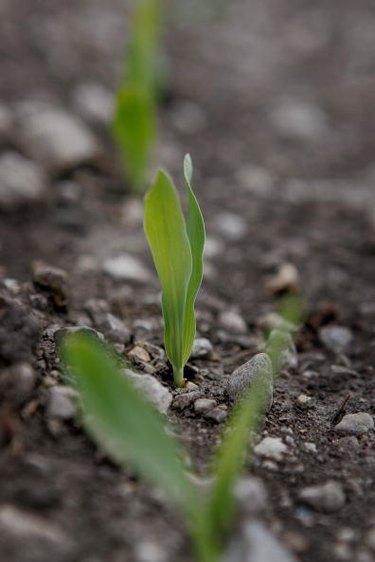
Germination is the process by which a plant grows from a smaller seed (or "germ") into a larger, mature plant. Germination can be epigeal, above the surface, or hypogeal, below the surface, but the seed undergoes the same process either way. From initial absorption of water to the seedling's emergence from the ground, seed germination is the process by which a plant's propagation is finalized and its species' survival guaranteed for another generation.
Types of Seeds
Video of the Day
Seeds of angiosperms (flowering plants) can be divided into two broad categories: monocotyledons and dicotyledons, more commonly referred to as monocots and dicots. The cotyledon is the embryo's first leaf, and a monocot has one of these embryo leaves while a dicot has two. While gymnosperms do not fall into either of these groups, their seeds are similarly self-containing during dormancy, and they undergo the same general type of germination.
Video of the Day
Stage One - Hydration and Metabolism
In the first stage of germination, seeds begin to absorb water, a process called "imbibation." The seed coating softens as it absorbs water, and the seed then begins to metabolize, as the water triggers release of an enzyme that speeds cellular respiration, where starch is transformed into sugar.
Stage Two - Digestion of Stored Food and Translocation of Nutrients
In the second stage of germination, the seed breaks down food that had been stored during dormancy. Lipids and carbohydrates (glucose in monocots, starch in dicots) break down into sucrose, and this sucrose and broken-down protein components are shifted to a location in the seed where they can be used for energy and new proteins for the growing plant.
Stage Three - Cell Division and Growth
The final stage of germination is where the seed finally becomes a true autotroph, an organism that can take energy from the sun and transform it into useful energy for other life. During this final stage, metabolism continues and the cells of the embryo divide until the embryo becomes too large for the coating to contain it. When this occurs, the coating will rupture and the plant begins to emerge, first with the roots extending down into the soil, followed by the seeding reaching up into the air to begin the process of photosynthesis.