Why Are Agar Plates Kept Inverted Whenever Possible?

Why Are Agar Plates Kept Inverted Whenever Possible? thumbnail
Agar plates are used in biological laboratories to culture bacteria and other microorganisms.

Agar plates are used in cell and molecular biology by scientists to carry out research experiments. They are plastic petri dishes filled with agar mixed with nutrients that support the growth of a range of microorganisms, such as E.coli bacteria. They are considered a routine laboratory consumable, because they are used up rapidly and normally made in-house, in large batches, and subsequently stored.

  1. Bacterial Agar Plates

    • These plates are usually produced by scientific technicians by incorporating laboratory-grade agar with a bacterial broth such as Luria-Bertani, SOC, Terrific or Eosin-Methylene Blue. The broth-agar preparation is supplemented with other factors that may be required for the bacteria to survive or a specific antibiotic (for example, Ampicillin or Kanamycin) to prevent the growth of unwanted bacteria.

    Pouring Agar Plates

    • Agar plates are prepared by simply mixing the nutrient-agar mix with a pH-balanced salt solution and heating this up until it melts. Once it has cooled slightly, heat-sensitive supplements are added. This is poured while still warm (and therefore liquefied) into the bottom of each petri dish, allowed to dry and solidify into a surface on which bacterial suspensions can be placed. After the plates have cooled completely they are labeled and stored until use. Proper storage of agar plates is important to ensure that the correct bacteria are cultured up and no unwanted contamination occurs, which can interfere with experimental results.

    Storing Agar Plates

    • There are several ways to store agar plates, depending on what supplements they contain. If light-sensitive supplements are present, then the plates are stored in the dark, either by wrapping them in aluminum foil or keeping them in a light-proof container. Plates are always stored in a cold-room or a laboratory refrigerator at 4 degrees C or 39.2 degrees F. Cold storage can prevent or minimize the growth of unwanted microbiological contaminants.

    Inverting Agar Plates During Storage

    • Plates that are unused are always inverted or flipped upside down onto their lids during storage. This is to prevent the plate from undergoing evaporation if the plate is stored for extended periods, which can affect the efficiency of bacterial growth, or allow the growth of undesirable microorganisms such as molds.

    Inverting Agar Plates During Inoculation and Incubation

    • Once the plates have been streaked with a wet suspension of bacteria, this must be allowed to evaporate slightly before incubation overnight. However, a moderate amount of wetness will still be present. If the plate is not inverted during incubation, the bacteria will not be able to settle onto the agar properly, which will either prevent them from growing and forming colonies properly, or encourage the growth of undesirable microorganisms. Either one of these results will invalidate the experiment. In addition, any condensation or wetness can cause streaking, which will make picking and analyzing separate colonies much more difficult. Once the bacteria have formed colonies, the plate is also stored upside down to maintain moisture levels.

Related Searches:

References

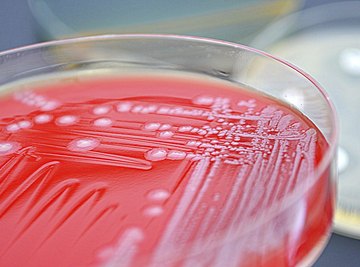
  • Photo Credit Bacteria Colonies image by ggw from Fotolia.com

Comments

You May Also Like

  • Why Are Agar Plates Incubated Upside Down?

    Agar plates are dishes of nutrient medium used to culture microorganisms and cells. They need a controlled environment and special handling.

  • How to Store Agar Plates

    Agar is a gelatinous material used as a medium for growing bacteria cultures. Agar plates refer to this gelatinous material in addition...

  • How to Make Agar Plates

    Agar is the gelatinous substance that sits inside the petri dishes used by scientists and students alike. Agar is the perfect substance...

  • Homemade Agar Plates

    Agar is a substance from the cell walls of red algae used in making petri dishes or "agar plates." Agar is a...

  • Types of Agar Plates

    Agar is a gelatinous polymer substance derived from red algae and commonly used in a biological laboratory setting as a substrate. Agar...

  • About Nutrient Agar Petri Plates

    Bacteria, like all organisms, need an energy source to grow. Liquid nutrient broth medium, nutrient agar slants and petrifilms containing nutrient agar...

  • How to Detect Contamination in Agar Plates

    Contamination often occurs when pouring or inoculating agar plates, even when researchers follow proper sterile technique. Bacterial and fungal spores in the...

  • Why Do You Invert an Agar Plate?

    Bacteria exist on almost every surface in our environment and inside our bodies, too. With so many diverse tiny organisms clustering together...

  • How to Identify an Agar Plate Colony

    You can inoculate an agar plate with microorganisms that are swabbed from your hands, desk or the handle on the restroom door....

  • How to Place the Inoculated Agar Plates in Inverted Positions

    In studying microorganisms, it is necessary for science students and scientists to grow cultures of specific strains of microbes. In order to...

  • How to Prepare LB Agar Plates

    LB agar (Luria Bertani) is a nonselective nutrient medium used to cultivate a large range of nonfastidious microorganisms. Agar has excellent properties...

  • How to Prepare Petri Dishes

    Preparing sterile Petri plates (dishes) is a basic task of all microbiology laboratories. The dish, or plate, preparation is relatively simple and...

  • Why Should You Always Label Your Agar Plates?

    An agar plate is a standard consumable used in most biological or medical laboratories to culture up a range of microorganisms on...

  • How to Monitor Bacterial Growth

    Bacterial growth involves an increase in cellular constituents, which is achieved by creating new protoplasm. Asexual reproduction of this nature involves duplication...

  • Methods to Isolate Bacteria

    Bacteria are essential for proper functioning of ecosystems. They decompose dead organisms and recycle organic material back into mineral nutrients. Isolating ...

  • Possible Sources of Contamination of Nutrient Broth & Agar Preparations

    Agar is a gelatinous substance derived from seaweed and used as a substrate for the cultivation of target species of microbes, fungi,...

  • Simple Method of Pouring Agar Plates

    Agar plates are standard experimental components used very rapidly in molecular biology laboratories. They are used to culture colonies of microorganisms such...

  • Why an Image Forms Upside Down in the Eye

    Light rays reflecting from what we look at travel from various directions to our cornea, which is curved inward like a bowl....

  • How to Pour Agar Plates

    Agar plates are used by doctors and scientists of many different disciplines for culturing bacteria and diagnosing illness. Once the agar medium...

Related Ads

Featured