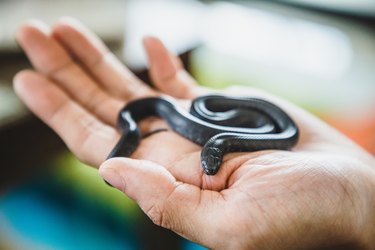
At first glance, a newly hatched baby snake might look like a worm, but a closer look reveals a scaly covering rather than a moist, rubbery surface. One feature that newly hatched baby snakes have in common is a single fang, or "egg tooth," that they use to cut their way out of leathery eggs. This small but sometimes visible fang falls off soon after the snake's first shedding.
Video of the Day
Most baby snakes, adorably called snakelets or hatchlings, look like the adults of their species but smaller. Baby snakes are usually 5 to 12 inches long (although baby pythons can be 24 to 30 inches). Identifying the specific snake species depends on the area in which you live, assuming you've found a wild baby snake. Clearly, determining the species of a wild baby snake is important if your goal is to avoid venomous copperheads, which can be dangerous, or identify types of king snakes, which are not dangerous.
Video of the Day
Characteristics of baby snakes
Of the 3,000 snake species humans have identified, about 70 percent lay eggs. The others bare live young. Boa constrictors, rattle snakes, and garter snakes, for instance, do not lay eggs. Baby snakes often look after themselves the moment they are born and are not fed by parents (except vipers and pythons).
They are vulnerable to predators, such as birds of prey. However, poisonous species are born with venom sacs that they are capable of using immediately, though they do not contain as much venom as adults.
Identifying baby copperheads
Baby or juvenile copperhead snakes look a lot like adults but they are smaller — about 7 to 10 inches long — and are grayer in color. The tip of their tail is vivid yellow. Copperheads outgrown their yellow tail by 3 to 4 years old.
Like most venomous snakes, copperheads are carnivores. Both baby and adult copperheads have reddish heads and hourglass-shaped markings. Copperheads are viviparous, meaning the eggs are incubated in the female's body, where the snakes hatch, and they are then born live.
Identifying types of king snakes
The baby king snake has many subspecies, but identifying types of king snakes is usually easy. They all have a distinctive pattern that can be red, yellow, orange, tan, black, or white that appears as bands, rings, stripes, patches, spots, or speckles. The head of a king snake is wider than the neck, and baby king snakes have bulging eyes. King snakes eat other snakes, even venomous ones.
Female king snakes lay a clutch of eggs under leaves or in fallen logs and leave them to hatch two or three months later. Some species of king snake, such as the scarlet king snake, have markings similar to the poisonous coral snake, making it easy to confuse them, especially as hatchlings.
Identifying baby rat snakes
The rat snake is sometimes confused with the copperhead, but the rat snake is not venomous, so it does not have fangs, only many small teeth. Also, rat snakes do not have pits on the side of their head like vipers. They have turtlelike heads. Like adults, baby rat snakes have round pupils, not vertical ones like copperhead snakes.
There are several species of rat snakes, but none are venomous. Females lay eggs mid-July in clutches of five to 20, and they hatch four to six weeks later. Not all baby rat snake species look like adults. The Eastern rat snake, for instance, is shiny black as an adult, but juveniles are pale gray with gray and brown patches. Rat snakes primarily eat rodents.
Identifying baby garter snakes
Different species of garter snakes are found across North America, but they are all harmless and bear live young, which are so small that they are often mistaken for worms. However, you can find as many as 40 born in a nest at once, which is a clue that these are newly hatched snakes, not worms.
Garter snakes have small, slender bodies and a distinctive dorsal stripe that's a different color depending on species. Baby garter snakes usually shed their skin after 10 days of life.
- All Things Nature: What Is An Egg Tooth?
- Fauna Facts: Baby Snakes Guide (All You Need to Know)
- San Diego Zoo: Kingsnake
- Pets on Mom.com: How to Tell the Difference in Copperhead & Black Rat Snakes
- Everything Reptiles: 20+ Types of Garter Snakes: How to Identify These Garden Snakes
- Clemson Cooperative Extension: Identifying Copperhead Snakes