DjelicS/iStock/GettyImages
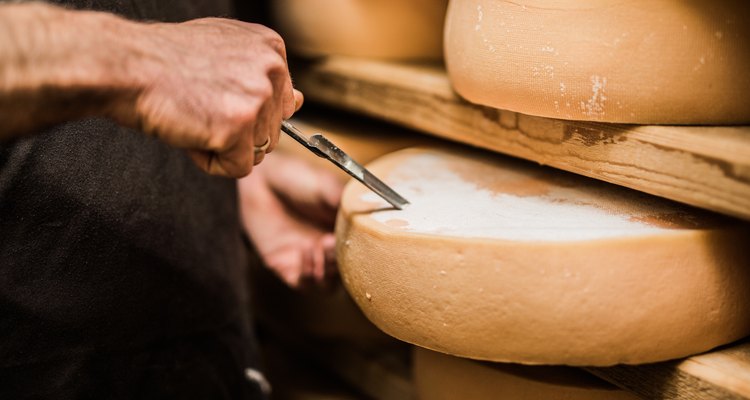
Muenster cheese is made from cow's milk and generally has a mild flavor with a smooth texture. It has a white interior with a rind that's colored orange from a vegetable dye. The American version is aged for a very short time while the European version has a stronger flavor due to its greater aging. You'll typically find Muenster cheese in grilled-cheese sandwiches, quesadillas and tuna melts.
Pasteurize whole cow's milk to kill most of the bacteria that might be harmful to humans. Pasteurization is the process of heating milk for some minimum time and temperature, usually 145 degrees Fahrenheit for 30 minutes. A higher temperature means that the heating time can be shorter. The United States generally requires all cheeses that are to be aged for less than 60 days (such as Muenster cheese) to be made from pasteurized milk. However, European cheeses don't have this requirement.
Skim most of the fat from the milk and heat it. Add rennet and bacteria. Rennet is a complex of enzymes produced in mammalian stomachs which digests milk. The bacteria used in this step have been specifically developed to produce Muenster cheese.
Allow the treated milk to curdle and cut away the resulting curd. Drain the whey. The whey is the liquid portion that contains water and a variety of proteins. Place the curd into molds and allow it to stand for 24 hours.
Remove the cheese from the molds and rub with salt or dip them in brine. This prevents the surface of the cheese from being contaminated by undesirable bacteria. Age Muenster cheese for an initial period of about three weeks.
Complete the aging process. Small Muenster cheeses are typically aged for six weeks, while larger cheeses may be aged for up to three months. Wash the cheeses with brine periodically during the aging period. As with other cheeses, the odor and taste of Muenster cheese becomes stronger as it ages. Cut some of the rind off to remove the salt and color the remaining rind with an orange vegetable dye.
Related Articles

Can You Eat the Skin on Muenster Cheese?

What Type of Microorganism Is Used to ...

Aged Cheeses That Do Not Melt
What Is Animal Rennet?

Calories in Pimento Cheese
What Good Bacteria Is in Cheese?

Facts About Gouda Cheese

Cheeses Similar to Feta
How to Cook With Havarti Cheese
MSG and Parmesan Cheese

What Makes a Cheese Mild, Medium or ...

What Types of Cheeses Are Unpasteurized?

How to Tell if Mozzarella Is Bad
How to Store Parmesan Cheese

How to Crumble Gorgonzola Cheese

How to Pan-Fry Cheese
Can You Make Homemade Mozzarella Cheese ...
A List of Foods Containing Microbes

How Can I Tell If Ricotta Cheese Has ...

How to Use Ricotta Cheese for Cream ...
Writer Bio
Allan Robinson has written numerous articles for various health and fitness sites. Robinson also has 15 years of experience as a software engineer and has extensive accreditation in software engineering. He holds a bachelor's degree with majors in biology and mathematics.