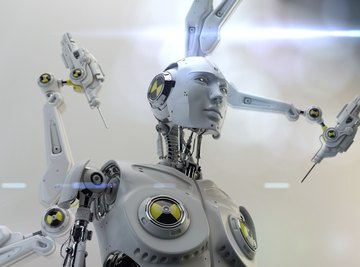

Science fiction might not appeal to every reader or viewer, but public interest in the genre has increased. In 2008, 41.4 million TV watchers claimed to watch science fiction shows. In 2013, 47.58 million people tuned in to watch sci-fi episodes, according to Statista. The genre encompasses short stories and books, movies, television -- and sometimes even a place where science fiction intersects with science facts.
Scary Themes
Science fiction stories have common themes, such as space travel, scientific progress, catastrophic events, supernatural powers, alien invaders, robots and the dangers of machines. For example, in Douglas Adams' novel "The Hitchhiker's Guide to the Galaxy," the protagonist and his alien friend navigate outer space and defeat evil Vogons who plan to destroy Earth. In the blockbuster hit "The Matrix," a human computer hacker defeats a race of machines that feed off human energy and erase human minds. Sci-fi themes often have underlying social or political messages that address human interactions on a global level.
Universal Robots
The term "robot" wasn't invented by scientists or alien life forms. Karel Capek, a Czechoslovakian author, wrote a play in 1920 called "R.U.R. -- Rossum’s Universal Robots." Capek derived the word "robot" from a term in the Czech language that means forced labor. In his play, humans are threatened with extinction when robots try to take over the world. Authors and producers often strive to make robots seem as human as possible. In the 1968 novel "The Iron Man" by Ted Hughes, later made into a 1999 animated film entitled "Iron Giant," a huge, three-story metal robot survives by consuming old metal parts on a family farm turned junkyard. Eventually, the robot sacrifices its life for a boy it befriends.
Beam Me Up
Teleportation isn't just a bizarre and crazy travel method used by characters in sci-fi books and movies such as "Star Trek." According to NASA, the "basic premise of teleportation is sound." Scientists at the National Institute of Standards and Technology in Boulder, Colorado, successfully teleported individual atoms using the principle of quantum entanglement. Some technology experts believe teleportation could eventually lead to the production of lightning fast quantum computers. However, there's no evidence to show that scientists will ever be able to teleport human beings -- that concept is purely science fiction.
Subgenres Galore
Science fiction contains a wide range of categories and attributes. There are over 36 subgenres of science fiction, according to SciFiLists.com. Subgenres include space opera, steampunk, space Western, retro futurism, nano punk, gothic science fiction, slipstream and pulp science fiction. Better-known subgenres include hard science fiction, alien invasion, robot fiction, superhero fiction, apocalyptic science fiction, zombie fiction and time travel.
Superhero Powers
Honorable, heroic characters contribute to the popularity of science fiction. For example, Superman has super powers, but his moral code doesn't allow him to kill anyone, according to StarPulse.com. As a result, he must use his supernatural abilities, such as X-ray vision, to protect himself, defend others and solve crimes. Superman isn't the only one who can see through walls with his X-ray vision. In 2013, students at the Massachusetts Institute of Technology developed a way to see through walls -- a method they call "Wi-Vi." Wi-Vi tracks movements through walls using an inexpensive wireless system that could potentially be installed in smart phones or small hand-held devices. This could help rescuers search for victims trapped in rubble or aid law enforcement agents in their quest to defeat crime. The best part -- you don't have to wear blue tights and a red cape to use Wi-Vi.
Epic Sci-Fi Thriller
Big-screen movies elevated science fiction to a new level. One of the most critically acclaimed science fiction movies -- George Lucas' "Star Wars" -- is the second highest grossing movie of all time when you adjust sales for inflation, according to Celebrity Networth. Box Office Mojo reports that the gross income, including adjustments for ticket price inflation, exceeded $1.4 billion as of 2014. That's not bad considering Lucas produced the film on an $11 million budget and agreed to a $150,000 salary plus merchandising rights. Darth Vader, Luke Skywalker and R2-D2 will forever remain science-fiction legacies, and "Star Wars" will always be remembered as a gigantic box office hit.
References
- Encyclopaedia Britannica: Karel Capek
- Celebrity Networth: How One Brilliant Decision in 1973 Made George Lucas a Multi-Billionaire Today
- Box Office Mojo: All Time Box Office
- NASA: Science Fiction or Science Fact?
- ComputerWorld: MIT Researchers Can See Through Walls Using Wi-Vi
- Statista: TV Program Type: Science Fiction
About the Author
As curriculum developer and educator, Kristine Tucker has enjoyed the plethora of English assignments she's read (and graded!) over the years. Her experiences as vice-president of an energy consulting firm have given her the opportunity to explore business writing and HR. Tucker has a BA and holds Ohio teaching credentials.
Photo Credits
Ociacia/iStock/Getty Images