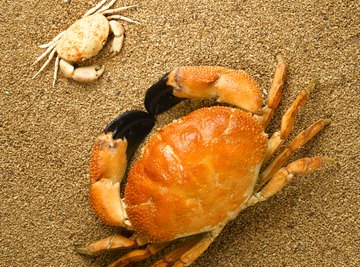

Crustaceans are one of the most diverse types of animal on our planet. They range from microscopic creatures to massive spider crabs whose claw-span can grow up to 11 feet and 9 inches. Researchers estimate that nearly 44,000 species have been identified to date in a wild assortment of shapes, sizes and type. But the crustacean respiratory system operates similarly in all of them, as the organisms breath with gills.
TL;DR (Too Long; Didn't Read)
Crustaceans breath through gills, an organ of the crustacean respiratory system that extract oxygen from water.
What are Crustaceans?
Crustaceans are a kind of arthropod. Arthropoda is the phylum, or wider classification group, given to animals with exoskeletons, jointed legs and distinctly divided body parts. Insects, spiders and centipedes are all arthropods. Crustaceans are a primarily aquatic arthropod, with at least five pairs of legs. Shrimps, crabs, crayfish and lobsters are all crustaceans. The name "crustacea" comes from the Latin word meaning "crusted forms," which is particularly apt for some of the more armored crabs found on sea shores.
What are Gills?
Crustaceans breath oxygen, as does (nearly) every other creature on earth. As they are aquatic creatures, they use the same respiratory system as fish and breath oxygen through gills. Gills, a crustacean respiratory organ, are very similar to lungs in the way that they function. Small molecules of oxygen get pulled into the blood stream as they pass over the gill's or lung's surface. The major difference is that gills pull oxygen from water and not air.
Tips
Fun facts about lobsters: A lobster has ten gills, each attached to one of the lobster's ten legs.
Where are their Gills?
A crustacean's gills are found in either the thoracic cavity (chest cavity) or on appendages. If they are on appendages they might be visible. The will look like feathered areas at the end of legs or at the junction between legs and body shells. The feathered effect is due to the structure of gills, which need as much surface area as possible to be able to get the most oxygen from water flowing over them.
How can some live on land?
Most crustaceans are fully aquatic, like shrimp and many types of crabs, and breath under water. Some are amphibious like the crabs found on sea shores or semi-amphibious as is the case with land-crabs who only return to water to breed. These are adapted to breath both in and out of water. Many live their entire lives on land, far from seas or lakes. Woodlouse are a common land-dwelling crustacean. Crustaceans that breath air have adapted to living out of water by changing the way they use their gills. They excrete a liquid, which is pushed over their gills. Oxygen to fuel their respiratory systems is pulled from this excreted liquid.
References
About the Author
Louise Jones has been a technical writer since 2006 and is the director of a technical writing company, providing literature for U.K. construction firms such as MITIE and Balfour Beatty. Her work also appears on various websites, focusing on business and technical articles. Jones has a postgraduate certificate in education and has been trained in information technology. She studied English at Cambridge University.
Photo Credits
Jeffrey Hamilton/Lifesize/Getty Images