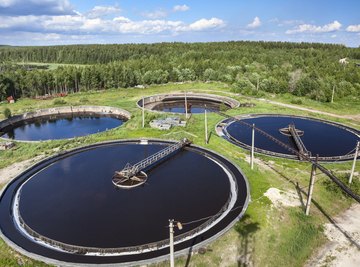
A waste water treatment plant cleans sewage and water so that they can be returned to the environment. These plants remove solids and pollutants, break down organic matter and restore the oxygen content of treated water. They achieve these results through four sets of operations: preliminary, primary, secondary and sludge treatments. Normally, a network of sewers connected to homes, commercial buildings, schools and street grates delivers waste water and solids to a treatment plant's collection tanks and basins in a never-ending flow.
Pretreatment Phase
Waste water plants remove the 'easy pickings' during the pretreatment phase. A set of bar screens rakes away large items such as tree limbs, garbage, leaves, cans, rags, plastic bottles, diapers and other waste materials. In many plants, equalization basins and grit chambers of various types regulate the rate of water inflow so that stones, sand and glass settle out. The basins hold sewage until it is ready for treatment and handle overflows due to heavy rains. Some plants skim grease and fats off the surface of the water during pretreatment, sometimes using air blowers to whip the oily material into a froth for easier removal. Other plants remove grease during primary treatment.
Primary Treatment
After pretreatment, the waste water collects in primary clarifiers, which are large basins and sedimentation tanks. Gravity allows smaller particles to settle out. Mechanically driven scrapers collect solid matter and direct it to hoppers connected to the sludge treatment equipment. If the plant didn’t remove grease and oil during pretreatment, it does so in this phase using surface skimmers. Some plants use equipment to saponify collected fats by mixing them with lye, thereby producing soaps and glycerol.
Secondary Treatment
In the next phase, plants aerate and agitate the waste water in secondary basins, adding beneficial microorganisms to break down organic matter into sludge. Plants employ a number of alternative strategies to break down sludge. For example, plants can culture a mass of microbes and pass the waste material over the biofilm. Other plants mix the biomass with waste material, creating activated sludge that can be recycled for reuse. The resulting biological floc removes carbon and nitrogen from organic wastes. Oxidation can occur on the surface—in lagoons—or in filter beds containing coked coal and limestone. Some facilities construct wetlands and reed beds that decompose organic materials. Other technologies used include membrane bioreactors and biological aerated filters. The resulting waste water collects and settles in a secondary clarifier tank.
Sludge Treatment
The final phase is to treat the remaining water and biosolids, or sludge. Gravity separates organic waste from heavier grit, which can be deposited in a landfill. The remaining primary sludge passes to a thickener, where it is centrifuged and fed to digesting tanks containing anaerobic bacteria. These tanks produce methane that can be used to power the plant. The final solid product, stabilized sludge, can be partially deodorized and plowed into soil as fertilizer. The remaining waste water is treated to remove phosphorus, nitrogen and other nutrients, disinfected with chlorine, ozone or ultraviolet light and then returned to the water supply. All discharge from and equipment used by waste water treatment plants must meet U.S. Environmental Protection Agency standards.
References
About the Author
Based in Greenville SC, Eric Bank has been writing business-related articles since 1985. He holds an M.B.A. from New York University and an M.S. in finance from DePaul University. You can see samples of his work at ericbank.com.
Photo Credits
antikainen/iStock/Getty Images