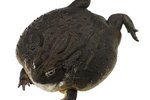
A mudpuppy, also called a waterdog in some parts of the United States, is actually a large salamander. Mudpuppies, in the scientific class of amphibians and the scientific order with salamanders and newts, are generally brown or gray and some have dark spots.
Mudpuppies, with the scientific name Necturus maculosus, have three sets of gills on the sides of their heads and a fin on their tail, similar to salamanders in their larval stage of other species. Mudpuppies are completely aquatic and never come onto land. They are found in lakes, ponds and rivers throughout eastern and central North America.
Mudpuppies hide under rocks or sticks in the water during the day, but come out at night to walk along the bottoms of the waterway in search of food. Their diet includes small fish, crayfish, insects and snails.
Courtship
Mudpuppies mate in the fall and, although mudpuppies don't hibernate, the female will not lay her eggs until spring. The male will join the female in a sheltered area, under a rock or log, in shallow water. The male mudpuppy begins the courtship with a swimming ceremony.
Mating
As he swims and crawls around the female, the male mudpuppy deposits a mass of jelly-like sperm. The female then moves over the sperm masses and takes them into her cloaca. In April or May, she will deposit about 100 eggs within a nest she digs out under rocks or sticks in the water.
Eggs
After she lays the eggs, they hatch in 30 to 50 days. The female mudpuppy stays with her nest until the eggs hatch, but will swim away when the babies emerge in their larval stage.
Larvae
The larva mudpuppy will begin to grow legs when it is about one-month old. It will be light in color with dark gray stripes. While most amphibians will go through metamorphosis during the larval stage that will allow them to exist outside of water, the mudpuppy does not. The mudpuppy retains its three sets of gills into adulthood.
Adult
The mudpuppy takes up to two years to reach adult size and lose the stripes of a juvenile. It will reach sexual maturity within five years and can live an additional 25 years.
The adult will live under rocks and logs within the water and has been seen at depths of up to 70 feet. The mudpuppy will average a length of eight to 13 inches.
References
Photo Credits
-
http://en.wikipedia.org/wiki/File:Necturus_maculosus_maculosus.jpg
Writer Bio
Bethney Foster is social justice coordinator for Mercy Junction ministry, where she edits the monthly publication "Holy Heretic." She is also an adoption coordinator with a pet rescue agency. Foster spent nearly two decades as a newspaper reporter/editor. She graduated from Campbellsville University, receiving a Bachelor of Arts in English, journalism and political science.