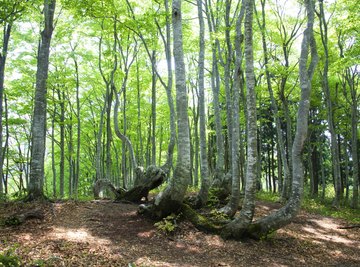
Green plants are not just important to the human environment, they form the basis for the sustainability and long-term health of environmental systems. Green plants remove carbon dioxide from the atmosphere and generate the oxygen required for life. Green plants are also a good source of food and protection.
Photosynthesis
Photosynthesis is the process that green plants use to convert light into chemical energy, in the form of energy-rich sugars, required for growth. The green color in plants results from a chemical known as chlorophyll. Chlorophyll absorbs the blue and red portions of the light spectrum but reflects green light, making most plants appear green. Photosynthesis consumes carbon dioxide as part of the photosynthetic process, emitting oxygen as a byproduct.
Oxygen
An important byproduct of photosynthesis is oxygen. According to the North Carolina State University, a single large tree can produce enough oxygen for four people in one day.
Carbon Dioxide
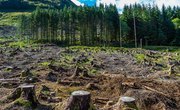
Plants use carbon dioxide while photosynthesizing, removing it from the atmosphere. The World Bank estimates that 20 percent of increasing atmospheric carbon dioxide levels has resulted from deforestation. They estimate that as much as 50 percent of global warming over the past 50 years is due to changing land use patterns and deforestation in the modern age. A single tree is estimated to absorb 1.33 tons of carbon dioxide per 100 years, an average of just over 26 pounds of carbon dioxide per year.
Natural Cooling and Soil Stabilization
Green plants provide natural cooling. Leaves block the heating effect of the sun. Green plants can also cool through transpiration, although without large numbers of trees and other plants this effect is minimal. Transpiration is the process by which water evaporates from plant pores, cooling the environment via evaporative cooling. Evaporation consumes heat and is most effective for cooling when the humidity is low. Plants also stabilize the soil through their roots, which bind soils, and through their leaves, which keep raindrops from eroding soils. Areas without adequate vegetative cover often suffer from large quantities of sediment washing into streams and lakes, diminishing water quality.
Food
Green plants are the basis of food webs. Animals, birds, insects and microbes feed on green plants. These organisms are subsequently eaten by larger animals, which are themselves eaten by even larger animals. For example, a rabbit eats grasses. The rabbit is eaten by a fox, which a mountain lion may then consume.
Protection
Green plants, especially trees but also scrubby underbrush, provide cover and shelter for many animals and plants. A tree provides shade for smaller plants growing in the understory. The same tree may provide an ideal place for a bird to build a nest. The Dust Bowl of the 1930s was caused by farmers removing protective trees. The removal of the trees, combined with severe drought, allowed wind to remove the topsoil of many farms, causing severe crop damage. One solution to the problem was to plant rows of trees around cultivated fields to block the wind.
References
About the Author
Although he grew up in Latin America, Mr. Ma is a writer based in Denver. He has been writing since 1987 and has written for NPR, AP, Boeing, Ford New Holland, Microsoft, RAHCO International, Umax Data Systems and other manufacturers in Taiwan. He studied creative writing at Mankato State University in Minnesota. He speaks fluent Mandarin Chinese, English and reads Spanish.
Photo Credits
KEITA SAWAKI/a.collectionRF/amana images/Getty Images