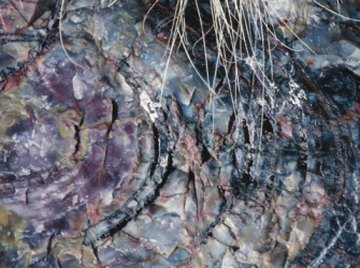

You hear them spoken about in the media frequently – fossil fuels and precious minerals or gems, both of these resources draw people because they can fetch a pretty penny in their sale. The decomposition of formerly living organisms results in fossil fuel generation. Some of these organisms have been dead and buried for many millions of years. Minerals are inorganic substances that occur naturally and often form an exact crystalline structure.
Non-Renewable Resources

Because fossil fuels take many millions of years to form, they are non-renewable resources. It would take many millions more years to regenerate and replace a supply equal to the amount people now use daily. Because people cannot produce more of these resources, scientists strongly recommend increasing research and use of renewable energy, which is readily available from sources such as sun, water and wind. Steadily transferring to renewable energy can prevent eventual collapse when these resources run out.
In addition to the short-lived nature of these resources, extraction and use of fossil fuels also creates amounts of carbon dioxide that twice exceed the amount that a natural process can absorb. Carbon dioxide is a greenhouse gas that enhances atmospheric radiation and raises the heat on Earth’s surface. Global warming is the culprit in major adverse changes that affect weather and ice melt.
Fossil Fuel Importance
The fossil fuels people use frequently in their daily lives and in manufacturing and industry – for example, coal, natural gas and petroleum – have a high concentration of carbon. A fossil-based fuel burns hot and is capable of producing energy in significant amounts. Windmills and waterwheels were the available energy supply for early industrial processes, but the advent of fossil fuels was the driving force behind the Industrial Revolution.
Automobiles and trucks began using internal combustion engines, and the demand for fossil fuels in the form of gas and diesel oil increased. Fossil fuels also play a large role in generating electricity. Additionally, tar is a byproduct of petroleum extraction, and road construction depends on tar's availability.
Six Crystal Groups
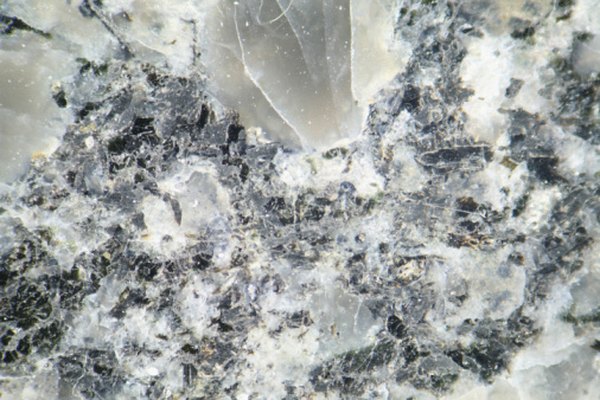
Minerals come in a wide variety of shapes and sizes. The six crystal groups define the properties of a mineral. All minerals have some of these properties, which include color, crystal, fracture, hardness, luster, specific gravity and tenacity. Some minerals might deviate from one or more of these groups, but there are limits of tolerance that come into play when defining a mineral.
Researchers have classified more than 3,000 different minerals, and miners constantly discover new ones as well. Minerals have an economic value — a globally desirable need or some meaningful, intrinsic property. Two well-known minerals are only marginally a mineral, and actually classify as a "mineraloid."
Organic Minerals and Mineraloids

One mineraloid is mercury, which has no crystal structure because it is a liquid. Another is opal, which lacks a chemical formula and crystal structure. Because they lack vital elements of classification for minerals, mineralogists classify them as mineraloids.
There is one other unique category, and that is the organic mineral. Although by definition a mineral is inorganic, several natural and rare organic substances have a distinctive chemical formula. The best example of this is whewellite.
The Final Distinction
The most notable difference between minerals and fossil fuels is the distinction between organic and inorganic substances. Scientists are able to duplicate minerals in a laboratory, which are called synthetics. This makes minerals a renewable resource.
Fossil fuels are organic in nature and fossilized over many million years. Using them diminishes supply, which takes many millions of years to replenish. Scientists are not able to duplicate this process in a laboratory. Therefore, they classify fossil fuels as a non-renewable resource.
References
About the Author
Julie Scott began writing professionally in 2000. She has written numerous articles for several websites. Scott has a Bachelor of Science from Worcester State University and Master of Science from Boston University.
Photo Credits
Hemera Technologies/Photos.com/Getty Images