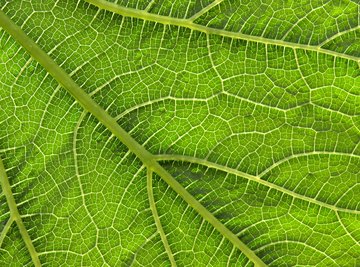

Plants act as a good complement to humanity, as the latter species breathes out carbon dioxide, which the plants then turn it into the oxygen humans need to live. Plants take in carbon dioxide, nutrients from the soil, water, and sunlight and create oxygen and a kind of simple sugar that they use for energy. This is a process necessary to life on Earth.
TL;DR (Too Long; Didn't Read)
Photosynthesis acts as an important factor that sustains life on Earth. Plants take in carbon dioxide, sunlight, water, and nutrients from the Earth and turn it into sugar and oxygen, which many species need to breathe.
Plant Inhalation and Exhalation
Humans and animals exhale carbon dioxide as a byproduct of respiration. Plants extract the carbon dioxide from the air and use it in photosynthesis process to feed themselves. The carbon dioxide enters the leaves of the plant through small pores called stomata. Once the carbon dioxide enters the plant, the process begins with the help of sunlight and water.
During this process, the plant combines carbon dioxide with water to allow the plant to extract what it needs for food. The plant uses sunlight as energy to perform this chemical reaction. Photosynthesis separates carbon dioxide and water — known as CO2 and H2O, respectively — into their individual molecules and combines them into new products. Once the process is done, the plant releases Oxygen, or O2, into the surrounding air. It also creates C6H12O6, a substance similar to glucose, that feeds the plant.
Where Excess Food Goes
Because they often receive more carbon dioxide and water than they need to sustain their own lives, plants often produce extra food during photosynthesis. In cases like this, plants store this excess food in other areas of its body. In some plants, this food is stored in fruits and vegetables — some of which, humans and animals eat. In a round-about way, the carbon dioxide taken into plants also helps provide food for humans and animals in addition to themselves. Some plants also store excess energy in their leaves.
Importance of Photosynthesis
In addition to making food for plants to survive, photosynthesis is an important part of the life cycle of all living things, as most fauna — animal life — require oxygen to survive. Oxygen is in limited supply in the atmosphere: if there was no way to transform the carbon dioxide emitted by living things back into oxygen, life would be unsustainable in the long term. Because plants are able to use the carbon dioxide and change it back into oxygen, life is able to continue for all living things, forming an important cycle.
References
About the Author
Kimberly Turtenwald began writing professionally in 2000. She has written content for various websites, including Lights 2 You, Online Consultation, Corpus Personal Injury and more. Turtenwald studied editing and publishing at Wisconsin Lutheran College.