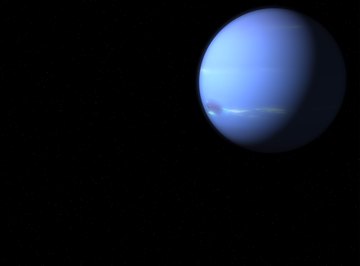
Thousands of objects orbit the sun, but there are only eight major planets. The ordinal configuration of the planets is Mercury, Venus, Earth, Mars, Jupiter, Saturn, Uranus and Neptune. These planets are split into an inner and outer group by an asteroid belt. In addition to the eight planets, the solar system is home to many dwarf planets, including Pluto.
Inner Planets
The inner planets, in increasing distance from the sun, are Mercury, Venus, Earth and Mars. These planets are all made of solid rock and rotate relatively slowly. They are smaller than the outer planets and more dense.
Outer Planets
The four outer planets, in increasing distance from the sun, are Jupiter, Saturn, Uranus and Neptune. These planets are all gas giants. They are less dense than the inner planets and spin quickly. All of the outer planets are encircled by rings of dust and rock. While Saturn has the most visible rings, all of the gas giant planets possess them.
Astronomical Units
Astronomical units are used to precisely specify the ordinal position of each planet. One AU is equal to the average distance of Earth from the sun. The ordinal position of a planet can be defined relative to this distance. For example, Mercury is roughly 0.39 AUs from the sun, whereas Neptune is roughly 30 AUs from the sun.
Asteroid Belt
The solar system's asteroid belt separates the inner and outer planets. The asteroid belt consists of thousands of pieces of rock and dust that never coalesced into planets. Mathematically, there should be a planet between Mars and Jupiter. The intensity of Jupiter's gravity, however, prevented the matter in the asteroid belt from forming a planet.
Dwarf Planets
In 2005, astronomers discovered another large object orbiting the sun. This object was eventually named Eris. The discovery of Eris prompted a debate, the outcome of which was a new category for classifying large objects in the solar system. Dwarf planets are massive round objects that orbit the sun but are incapable of forcing other objects out of their orbital path. Pluto, Eris and many other objects from the region beyond Neptune are classified as dwarf planets. Additionally, the asteroid Ceres was upgraded to dwarf planet status.
References
About the Author
Serm Murmson is a writer, thinker, musician and many other things. He has a bachelor's degree in anthropology from the University of Chicago. His concerns include such things as categories, language, descriptions, representation, criticism and labor. He has been writing professionally since 2008.
Photo Credits
Jason Reed/Photodisc/Getty Images