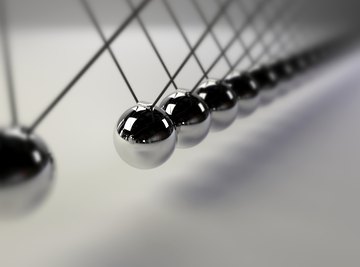

In physics, an oscillator is any device that continually converts energy from one form to another. A pendulum is a simple example. When at the top of its swing, all its energy is potential energy, while at the bottom, when it is moving at maximum speed, it has only kinetic energy. If you graphed the relationship of potential to kinetic energy over tine, you would get a repeating waveform. The movement of a pendulum is continuous, so the wave would be a pure sine wave. The potential energy that gets the cyclical process started is supplied by the work you do to lift the pendulum. Once you release it, the pendulum would oscillate forever if it weren't for the force of air friction that resists its movement.
This is the principle behind a resonating electronic oscillator. The voltage supplied by a DC power source, such as a battery, is analogous to the work you do when you lift a pendulum, and the electric current released, which flows from the power source, cycles between a capacitor and an inductive coil. This type of circuit is known as an LC oscillator, where L denotes the inducting coil and C denotes the capacitor. This isn't the only type of oscillator, but it's a DIY oscillator you can construct without the need to solder electronic components to a circuit board.
A Simple Oscillator Circuit – an LC Oscillator
A typical LC oscillator consists of a capacitor and inductive coil wired in parallel and connected to a DC power source. The power flows into the capacitor, which is an electronic device that consists of two plates separated by an insulating material known as a dielectric. The input plate charges to its maximum value, and when it reaches full charge, current flows across the insulation to the other plate and continues on to the coil. Current flowing through the coil then induces a magnetic field in the inductor core.
When the capacitor has fully discharged and the current stops flowing, the magnetic field in the inductor core begins to dissipate, which generates an inductive current that flows in the opposite direction back to the output plate of the capacitor. That plate now charges to its maximum value and discharges, sending current in the opposite direction back to the inductor coil. This process would continue forever were it not for electrical resistance and leakage from the capacitor. If you were to graph the current flow, you would get a waveform that gradually degenerates into a horizontal line on the x-axis.
Making Components for a DIY Oscillator
You can construct the components you need for a DIY oscillator circuit using materials around the house. Start with the capacitor. Unroll a sheet of plastic food wrap about 3 feet long, and then lay a sheet of aluminum foil on it that isn't quite as wide or as long. Cover this with another sheet of plastic identical to the first one, and then lay a second sheet of foil, identical to the first sheet of foil, on top of that. The foil is the conducting material that stores charge, and the plastic is the dielectric material analogous to the insulating plate in a standard capacitor. Tape a length of 18-gauge copper wire to each sheet of foil, and then roll everything into a cigar shape and wrap tape around it to hold it together.
To make an inductive coil, use a large steel bolt, such as a 1/2- or 3/4-inch carriage bolt, for the core. Wrap 18- or 20-gauge wire around it several hundred times – the more times you wrap the wire, the more voltage the coil will produce. Wrap the wire in layers and leave the two ends of the wire free for making connections.
You'll need a DC power source. You can use a single 9-volt battery. You also need something to test the circuit. You could use a multimeter, but an LED bulb is easier (and more dramatic).
Ready, Set, Oscillate
To get things started, you need to connect the capacitor and inductor in parallel. Do this by twisting one wire from the inductor to one of the capacitor wires and then twisting the other two wires together. Polarity isn't important, so it doesn't matter which wires you choose.
Next, you need to charge the capacitor. Do this with a pair of wires that have alligator clips on both ends or get a battery clip that fits the top of a 9-volt battery. Clamp one lead onto one pair of twisted-together wires and the other end onto one of the free battery terminals, then use the other wire to connect the other pair of wires to to the other battery terminal.
It may take 5 or 10 minutes for the capacitor to charge and the circuit to start oscillating. After this time has elapsed, disconnect one lead from the battery and clamp it onto one of the wires on the LED, then disconnect the other lead and clamp it onto the other LED lead. As soon as you complete the circuit, the LED should start flickering. That's the sign that the oscillator is working. Leave the circuit connected to see how long the LED keeps flickering.
Uses for a Capacitor Oscillator
The oscillator you can build with a foil-wrap capacitor and a carriage bolt inductor is an example of an LC tank circuit or a tuning oscillator. It's the type of oscillator used for sending and receiving radio signals, generating radio waves and mixing frequencies. Another important capacitor oscillator is one that employs capacitors and resistors to convert DC input signals to pulsating AC signals. This type of oscillator is known as an RC (resistor/capacitor) oscillator, and it usually incorporates one or more transistors into its design.
RC oscillators have multiple uses. There is one in every inverter, which is a machine that converts DC current to AC house current. An inverter is an important component of every photovoltaic electric system. In addition, RC oscillators are common in sound equipment. Synthesizers use RC oscillators to generate the sounds they make.
It isn't as easy to build an RC oscillator with found materials. To make one, you usually have to work with actual circuit components, circuit boards and a soldering iron. You can easily find diagrams for a simple RC oscillator circuit online. The waveform from a capacitor oscillator depends on the capacitance of the capacitors, the resistance of the resistors used in the circuit and the input voltage. The relationship is a little complex mathematically but easy to test experimentally by building oscillator circuits with a variety of components.
References
Tips
- For evidence that a current is actually oscillating between the capacitor and inductor, you can insert an ammeter or small light bulb into the circuit to see how fast it flickers. Or you can feel the inductor after a while and notice that its temperature increases because of the current flow.
Warnings
- Make sure not to touch the bare wires of the capacitor to anything other than the bare ends of the battery or inductor; otherwise, you can discharge it.
About the Author
Chris Deziel holds a Bachelor's degree in physics and a Master's degree in Humanities, He has taught science, math and English at the university level, both in his native Canada and in Japan. He began writing online in 2010, offering information in scientific, cultural and practical topics. His writing covers science, math and home improvement and design, as well as religion and the oriental healing arts.