
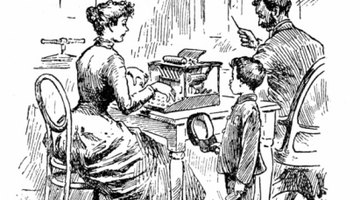

The Victorian period is so named because it spanned the years of the reign of Queen Victoria in England, from 1837 to 1901. The quality and form of a child’s education during that time depended upon the economic circumstances of his or her family, and also upon whether the child was a boy or a girl. High quality boarding school education was reserved primarily for the privileged, and almost exclusively for boys. There were also boarding schools for the lower classes, but they did not generally deliver a good quality education.
General Features of a Victorian Education
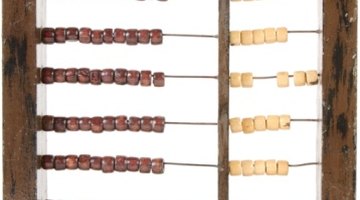
Learning in the Victorian boarding school was done by rote, with much recitation and repetition and relentless copying of subject matter on small slates using chalk, and into copybooks by means of a pen with a metal nib dipped into an inkwell. Fine handwriting was considered important, so much time was spent practicing letter and word formation. Geography was taught using a globe. Arithmetic skills were learned with an abacus. There was often time during the day for Bible reading, prayers and hymn singing.
The Victorian Classroom
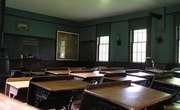
Classrooms in the Victorian era were grim places without much decoration. There might have been a stern text and a picture or map on the wall, but all illustrations were in black and white, with no thought given to cheeriness. Desks were arranged in straight rows facing the front of the classroom, where a blackboard and the teacher’s desk faced the students. Some classes were quite large and required the assistance of a teacher’s assistant or what were called “monitors” to help keep order among the students. Teachers were not well-paid and did not need a college education to qualify for the profession. At the beginning of the era, most teachers were men, but gradually more women entered the field.
Discipline
Discipline was strict and corporal punishment--a rap on the knuckles or palm with a ruler, or a swat across the backside with a birch cane--was common. Other punishments were the repetitious copying of lines and detention. A punishment log book kept track of punishments, which could be referenced when a student sought employment after graduation. A Dunce Cap, a tall pointed hat, was worn by students who were considered slow in their studies. These students were made to wear the cap and stand in full view of the other students as an example.
Lower Class Victorian Boarding Schools
Boarding schools for lower class boys were advertised in the London papers, and were considered useful places to put unwanted or illegitimate children. They were in business primarily to make a profit for their owners, and were places of harsh discipline, inadequate diet, and little learning. One such school advertised itself as a place in which “the strictest attention is paid to the health, moral conduct and intellectual improvement of [the owner’s] Pupils; and in order to expedite their Education as much as possible, he teaches assiduously in the School himself, and does not allow any vacations." Charles Dickens, in his novel “Nicholas Nickleby,” writes fictitiously about such a school, based on research he conducted in Yorkshire. Of the school in his novel, which he calls Dotheboys Hall, Dickens writes, "all runaways were, as a matter of policy, made severe examples of, at Dotheboys Hall, inasmuch as, in consequence of the limited extent of its attractions, there was but little inducement, beyond the powerful impulse of fear, for any pupil, provided with the usual number of legs and the power of using them, to remain."
Upper Class Victorian Boarding Schools
Young Victorian boys and girls, regardless of class, were mostly educated at home. When upper class boys reached the age of 10, however, they were sent to boarding schools like Rugby, Eton, Harrow, Winchester, Westminster, Charterhouse, and a small number of lesser schools. The curriculum in these schools was weighted towards the Classics, the languages and literature of ancient Greece and Rome. Boys participated in sports like football (soccer) and cricket. Although they set generally high standards, many of these schools at the beginning of the Victorian era were in need of reform. Over the decades during this period, such improvements as the reduction of class size, the hiring of better qualified staff, the expansion of the curriculum, and the improvement of living conditions contributed to the recovery of high educational standards.
Related Articles






References
Writer Bio
Laurel Cleary is based in Northern California. She has written for publication since 1992 on a variety of topics including parenting, science, faith and music. Her stories have appeared in “Welcome Home,” “Overtones," in church publications and online. She holds a Bachelor of Arts in geography from the University of California, Davis.