
Why Mineral Oil & Water Don't Mix

Why Mineral Oil & Water Don't Mix thumbnail
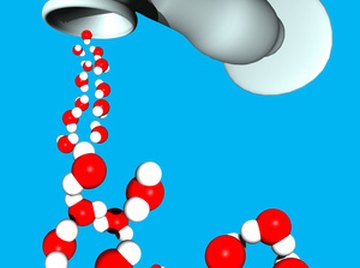
Water molecules like to stick together.

It's easy to conclude that mineral oil and water should mix well. They're both clear and odorless. However, if you put some mineral oil into a jar of water and shake it, the mineral oil won't mix with the water. That's because their molecules won't let them dissolve. No matter how hard you shake your jar, you might see the mineral oil breakup into small specks, but the water will not mix with the mineral oil.

  1. Like Attracts Like

    • Science expert Christopher Grayce compares the interaction between oil and water molecules to how boys interact with girls at recess. Grayce says, "Oil molecules like to stick to other oil molecules more than they like to stick to water molecules."

    Forcing Interaction

    • Unless the oil molecules have a way of joining with water molecules, the two will not mix. When an emulsifier like soap joins with water and oil, their molecules gain something in common that helps them form a bond. Otherwise, water and oil molecules can't mix. Mineral oil has nonpolar molecules and water has polar ones.

    Polar Molecules

    • Dr. Kent Simmons, a biology instructor at the University of Winnipeg, describes water molecules as having two ends. He says one end is positively charged and the other one is negatively charged. A water molecule is a polar molecule.

    Polar Bonds

    • This polar design of water molecules form a strong enough bond that lightweight insects like water striders won't sink as they walk on water. Their tiny feet don't have enough weight to pull water's molecules apart. So mineral oil's lighter weight plays a key role in why it won't mix with water water. Its nonpolar bond is not as strong as water's polar bond.

    Density

    • Elmhurst College professor Charles Ophardt describes density "as a physical property of matter." Density can be measured by matter's heaviness, or weight, by volume. Mineral oil's density is close to the weight of a water strider's step; it's not dense enough to pull the water molecule's bond apart.

Related Searches:

References

  • Photo Credit eau image by Rémi BORNET from Fotolia.com

Comments

You May Also Like

  • Define Mineral Oil

    Mineral oil is a transparent, colorless, oily liquid obtained by the distillation of petroleum (or crude oil). It is produced in large...

  • Why Oil Won't Mix in Water?

    Oil spills and salad dressings demonstrate an important scientific lesson: Oil and water do not mix. The reasons for this phenomenon relate...

  • How to Mix Mineral Oil Enemas

    While it may not be pleasant to administer an enema, they can be a medical necessity. Enemas clean out your system and...

  • How to Filter Mineral Oil With a Water Filter

    Mineral oil is a non-reactive, non-spoiling oil that is non-toxic--though it is used as a laxative, so be forewarned--non-conductive and with a...

  • Science Projects for Mixing Oil and Water

    Oil and water are considered immiscible liquids, meaning they will not blend together to form a homogeneous mixture. However, they can be...

  • How to Use Mineral Oil

    Mineral oil is a colorless and odorless oil that has a number of useful properties. Not only can mineral oil be used...

  • How to Explain to Preschoolers Why Oil Floats in Water

    Teaching children about science should begin as early as preschool. The concepts you introduce should be simple and easy for the children...

  • How to Mix Oil & Water With Food Coloring

    Most retail brands of food coloring are water-based, so they do not naturally mix with oil. To mix oil and water, you...

  • How to Emulsify Oil & Water

    Just about everyone knows that oil and water don't mix. But, with a little help from an emulsifier, they do blend and...

  • How to Remove Mineral Oil

    Oily residues naturally resist being dissolved by soaps and other lathering cleaners, making fabric stains caused by mineral oil among the most...

  • The Difference Between Synthetic & Regular Motor Oil

    The Difference Between Synthetic & Regular Motor Oil. Regular motor oil, sometimes called traditional or mineral-based motor oils, have been around for...

  • Why Can't We Drink Salty Water?

    Fresh water is a limited resource that is vital for human survival because humans cannot drink salt water. About 97 percent of...

  • How to Mix Mineral Oil

    Mineral oil mixtures are used to relieve constipation by stimulating the colon. A mineral oil mixture can be taken orally or used...

  • Mineral Oil Density Vs. Temperature

    Mineral oil is a type of oil made from crude oil, as opposed to oils made from plants or animal fats. This...

  • How to Mix Gasoline and 2-Cycle Engine Oil

    Many outdoor appliances such as leaf blowers, snow blowers, and weed whackers require you to mix gasoline and 2-cycle engine oil for...

  • How to Dissolve Minerals Into Liquid

    Dissolving is the process that occurs when the molecules that compose a chemical separate and become evenly dispersed between the molecules of...

  • How to Mix Synthetic and Mineral Oils

    For many years it was thought that the mixing of synthetic and mineral motor oil would lead to leakage and corrosion problems...

  • Physical Properties of Mineral Oil

    Mineral oils are complex mixtures of hydrocarbons derived from crude oil. They are mostly used for lubricating machines. Mineral oils are also...

  • Ways to Use Mineral Water

    All water naturally contains minerals, but water is deemed to be mineral water if, when it is evaporated at 180 degrees, certain...

  • How to Separate Emulsified Oil & Water

    Separating emulsified oil from water, two immiscible (non-blendable) liquids, can have a range of different applications. In the case of an environmental...

Related Ads

Featured