

Guidelines on Building Ponds in Arkansas

Expanding economic development programs in Arkansas are dependent in part on man-made ponds. The Smith-Lever Act of 1914 was a congressional mandate designed by US President Woodrow Wilson to legally authorize the United States Department of Agriculture (USDA), state land-grant universities and local governments to create practical guidelines for agricultural education. Based on this mandate the state of Arkansas authorized the Arkansas Cooperative Extension to created comprehensive recommendations for pond construction.
Types of Ponds
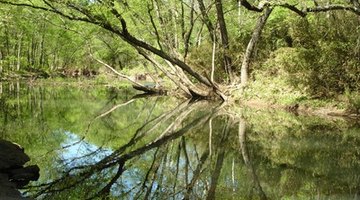
The USDA identifies two primary pond types. Embankment ponds are created by damming streams in depressed land sites that will permit five or more feet of water to collect from runoff and rainfall. Excavated ponds must be dug in a level area where the water table is reasonably accessible or water can be pumped in from a nearby source. Each pond type may be also be referred to as a watershed pond, or a levee respectively.
Pond Usage and Location
Primary pond use will determine location and pond type. The Arkansas Cooperative Extension recommends watershed ponds for fish production and recreation because they are cleaner and maintain a natural ecosystem with less effort. Levee ponds are better for irrigation, livestock watering and recreational fishing because placement options are more flexible and drainage is possible if drainpipes are installed.
Soil Content
The Arkansas Cooperative Extension recommends that pond soils include at least 20 percent clay to allow adequate compaction to hold water in the pond. Levee ponds and core trench fill for watershed pond dams must be manually compacted using equipment designed specifically for the purpose.
Water Capacity
Evaluation of necessary water capacity for a new pond should include assessment of adequate spillways, number of gallons per day necessary to serve livestock or provide irrigation and the variety of depths necessary for successful fish production and enjoyable fishing. Control of healthy vegetation is also more challenging if ponds are too deep or too shallow. Both the USDA and the Arkansas Cooperative extension recommend 6 to 7-feet with quick drop off to at least 2 to 2 1/2-feet as an average productive depth for all pond uses.
Special Considerations
Pond design can be tailored to multiple uses. Designated fishing areas should provide plenty of natural places for fish to hide and spawn. Irrigation pumps should be placed separately from fishing areas. Fencing ponds to prevent fish escape is not recommended as it clogs easily. The Arkansas Cooperative Extension recommends a parallel bar spillway barrier designed by The Alabama Department of Conservation and Natural Resources to prevent fish escape in high water.
Resources
Writer Bio
Smokey Yokems has been teaching through writing and performance since 1982. Yokems' strength is translation. Her publications include work-for-hire children's stories, corporate video scripts and a tri-annual newsletter for a nonprofit educational foundation in Maine. Yokems holds a Bachelor of Arts in creative writing and performance from Oberlin College/Lesley University.
Photo Credits
- spadra park arkansas image by Jackie DeBusk from Fotolia.com
More Articles

