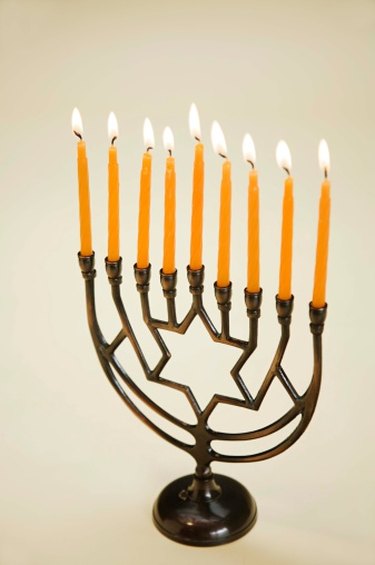
A Jewish holiday of relatively minor religious importance, Hanukkah is celebrated during Kislev, the ninth Jewish month. Beginning on the 25th day of Kislev, Hanukkah lasts for eight days. This holiday occurs every year during November or December.
Origin of Hanukkah
Video of the Day
In the Maccabean Revolt of the second century B.C., the Jews rose up against their oppressors of mixed Greek-Syrian origin. These oppressors, led by Antiochus IV Epiphanes, outlawed Judaism, killed thousands of Jerusalem residents and transformed the Second Temple into an altar devoted to Zeus. Led by Judah Maccabee, the Jews forced their oppressors out of Jerusaleum and rebuilt the Second Temple. During the rededication of the Temple, there was only enough oil to burn the candles for one day. However, the candles burned for eight consecutive nights, giving the Jews time to find more oil. The eight days of Hanukkah commemorate this miracle.
Video of the Day
Lighting the Menorah
During Hanukkah, Jews symbolically light menorahs. Menorahs have nine candles, one for each day of Hanukkah plus an extra candle in the center. This extra candle is called the shammus, or servant candle, and is lit first. On the first night of Hanukkah, Jews light the shammus and use its flame to light the candle on the far right of the menorah. On the second night, the shammus is lit, followed by the candle to the left of the first candle. Then, the first candle is lit. On each successive night, an additional candle is lit. Additional candles are always lit first (after the shammus), and then the candles are lit in order from left to right.
Hanukkah Foods
Because oil is so significant to the history of Hanukkah, traditional Hanukkah foods are fried in oil. During the eight days of Hanukkah, Jews make latkes (potato pancakes) and sufganiot (doughnuts).
Dreidel
Dreidels are another Hanukkah tradition. When Antiochus outlawed Judaism, Jews often concealed their illegal study of the Torah by playing dreidel whenever a Syrian was in sight. Similar to tops, dreidels have four sides, each marked with a letter. These letters stand for the Yiddish words meaning "nothing," "all," "half" and "put." When a player spins the dreidel, it lands with one of these letters facing up. These letters indicate how much money players must put in the pot and who gets to keep the money. The letters on the dreidel also correspond to the Hebrew words meaning "a great miracle happened there," a reference to the miracle of lights at the Second Temple.