

Mercury Thermometer Vs. Alcohol Thermometer

Table of Contents
Thermometers are designed to measure temperatures within specific ranges for various purposes. For the retail consumer, the most common applications are for cooking, health monitoring and inside/outdoor temperature.

Historically, mercury thermometers have been used for nearly all temperature measurements because of their accuracy and low cost. However, their use is increasingly being restricted to industrial and scientific applications, as safety and environmental issues are demanding stricter laws on the disposal of products containing mercury.
Identification

Thermometers are typically constructed of a hollow glass tube with a reservoir at one end to hold a liquid, which is sensitive to temperature fluctuations within a specific range. Mercury in its liquid form has traditionally been used because of its fluid properties of separation and adherence through temperature extremes. It is identified by its familiar silver metallic color. Thermometers containing a blue or red color liquid are most often utilizing an organic fluid, usually alcohol-based. Visual indicators are marked in degrees Fahrenheit, Centigrade or both.
Mechanisms of Action
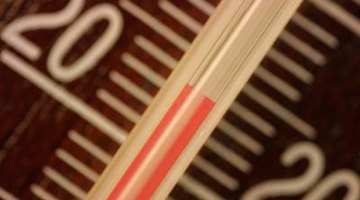
The coefficient of thermal expansion describes how the size of an object changes with a change in temperature. When something changes temperature, it shrinks or expands in all three dimensions. In a mercury- or alcohol-filled thermometer, it is the change in fluid volume that is important. Specifically, it is calibrated and measured at the volume per degree change in temperature at a constant pressure. Expansion or contraction of the glass tube and reservoir enclosing the liquid within is negligible, since liquids generally have a substantially larger coefficient of thermal expansion than solids. The manufacturer calibrates and marks the thermometer so the top of the fluid column (meniscus) indicates an accurate temperature reading.
Advantages & Disadvantages of Mercury Thermometers
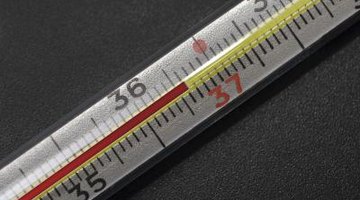
Mercury thermometers are inexpensive, durable and accurate. However, they present many safety and environmental hazards. Metallic mercury in its liquid state is relatively harmless when confined. However, in a gaseous state, as organomercuric compounds or as inorganic salts, it becomes a deadly toxin. Mercury is especially harmful to fetuses, infants and children.
The metallic mercury in thermometers, if introduced into the environment in a non-controlled manner, can eventually enter the water ecosystem, where microorganisms break it down to methylmercury components. Fish and sea animals at the top of the food chain of the ocean, lakes and streams consume these compounds in their diets, where they tend to accumulate in their body tissues. According to Medicinenet.com, all birds and mammals are threatened by death, reduced reproduction, slower growth, delayed development and abnormal behavior as a result of a diet high in contaminated seafood.
Advantages & Disadvantages of Alcohol Thermometers

Alcohol thermometers are also inexpensive and durable. They are typically not as accurate as mercury thermometers because of the alcohol’s susceptibility to evaporation, polymerization potential and capillary separation. Their primary advantage is safety to humans and the environment.
The major disadvantage of alcohol thermometers is the limited use at very high temperatures as in cooking, because of the low boiling point of the thermometer’s liquid contents. Thermister-based or “metal thermometers” are recommended in these applications, which do not utilize any liquid for temperature measurement.
Safety Considerations
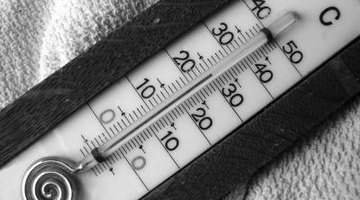
Broken alcohol thermometers can be disposed of in an ordinary fashion, being careful of any broken glass.
Mercury thermometers should never be accessible by infants or children.
A broken mercury thermometer should be handled as an emergency situation requiring immediate attention. The U.S. Environmental Protection Agency has excellent instructions on how to handle a broken mercury thermometer situation available online.
The Drip Cap
- Thermometers are designed to measure temperatures within specific ranges for various purposes.
- Thermometers are typically constructed of a hollow glass tube with a reservoir at one end to hold a liquid, which is sensitive to temperature fluctuations within a specific range.
- It is identified by its familiar silver metallic color.
- When something changes temperature, it shrinks or expands in all three dimensions.
- Specifically, it is calibrated and measured at the volume per degree change in temperature at a constant pressure.
- Mercury thermometers are inexpensive, durable and accurate.
- The metallic mercury in thermometers, if introduced into the environment in a non-controlled manner, can eventually enter the water ecosystem, where microorganisms break it down to methylmercury components.
References
- The World of Physics; John Avison; 1989
- MedicineNet.com: Mercury Poisoning
- U.S. Environmental Protection Agency: What to Do if a Mercury Thermometer Breaks
Writer Bio
Ken Appelt is a senior sales and marketing executive with experience that includes product design, research, production, quality assurance, distribution and education. He has been writing and publishing articles in since 1982, mainly in healthcare, medical device and scientific periodicals. He holds a Bachelor of Science in chemistry from the University of Wisconsin and a Master of Business Administration from Lake Forest.
Photo Credits
- Hemera Technologies/AbleStock.com/Getty Images
- Hemera Technologies/AbleStock.com/Getty Images
- Purestock/Purestock/Getty Images
- Hemera Technologies/AbleStock.com/Getty Images
- Ensup/iStock/Getty Images
- Evgeny Sergeev/iStock/Getty Images
- Racide/iStock/Getty Images
More Articles

