
The world is filled with angles. From the angle of a beam in a cross to the slope of a roof, you need tools to measure those angles with precision. Each profession has it own specialty tools to determine angles, but some are used in multiple trades and in the classroom. Choose the measuring tool that fits your application.
TL;DR (Too Long; Didn't Read)
T-squares, adjustable triangles, transit levels, protractors and set squares are some of the tools used to measure angles in architecture, surveying, geometry and carpentry.
Angles in Architecture
Architects drafting blueprints by hand for bridges or landscape design use a variety of tools to accurately measure distances and angles. Use a T-square to draw horizontal lines and measure 90-degree angles in relation to those lines. Use an adjustable triangle to measure angles between 0 and 90 degrees by placing it on the horizontal axis and adjusting the hinged edge till it lines up with the angled line you want to measure. If you need to copy an angle precisely, couple a compass with a ruler to measure the angle and draw an identical one.
Angles in Surveying
Surveyors use tools to measure horizontal and vertical angles in relation to the earth’s surface. A transit level has a movable telescope that is aimed at a rod to determine a horizontal level and the angle of inclination in degrees, minutes and seconds. This determines the grade of a roadway or the foundation of a home. Forestry professionals use a clinometer to calculate tree height from the angle formed between the clinometer and the tree. To measure the total height of a tree, look through the eyepiece of the clinometer at the highest tip of the tree then read the measurement on the dial. Add the measurement to the height from the instrument to the ground.
Angles in Geometry
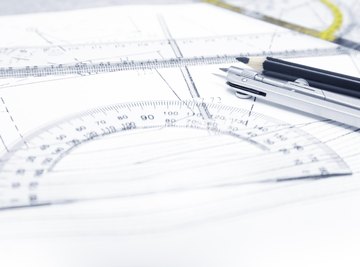
In geometry class, a protractor is a ruler with a semicircle attached to it. Lay its straight edge on the horizontal side of an angle and read where the hypotenuse -- or angled side -- crosses the protractor to determine the angle in degrees. Lay a set square on an angle of 30, 45, 60 or 90 degrees to determine the degrees. The angle of the triangle is preset to 30, 60 and 90 degrees on one type, and its direction determines the degrees of angle. Use a second set square to measure 45 and 90 degree angles.
Angles in Carpentry
In carpentry, a speed square is a three-sided "square" with angle measurements from 0 to 60 marked on its diagonal side. Measure angles by laying it along a board's edge and reading the degrees of angle. Use a bevel protractor to measure the angle on the end of a board by rotating the adjustable arm on the protractor until it clamps down onto the wood. Simply read the degrees on the dial to know the angle the wood is cut at.
References
About the Author
Diana K. Williams is a certified Master Gardener, has more than a decade of experience as an environmental scientist, and holds a Bachelor of Science degree in biology and environmental studies from the Ohio Northern University. Williams is a winner of Writer’s Digest Magazine's annual writing competition.
Photo Credits
Arman Zhenikeyev/iStock/Getty Images