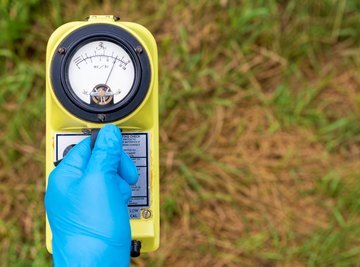
You can perform many experiments to investigate radioactivity safely in the classroom or even at home. Radioactivity is natural and around us all the time. Small amounts of radiation can come from a few store-bought items, from minerals and from space. If you have a Geiger counter, you can measure these sources and determine the shielding power of everyday materials. With a few supplies from a science catalog, you can do more sophisticated experiments.
Sources
To prepare a radioactivity experiment, you need some radioactive sources. You can purchase these through a scientific supply catalog. Most small sources are safe for a classroom and won't require a special license. Stronger research or medical-grade materials will probably require a license.
Equipment
To do almost any kind of radioactivity experiment, you'll need at least one accurate Geiger counter. Modern versions include a computer interface and software, making calculation and graphing tasks easier. If a computer's not available, you can use a stopwatch to time experiments by hand.
Background Radiation
Small amounts of radioactivity surround us, coming from minerals in the earth, from the sky, and the things we use every day. This is called background radiation. You can measure it with a Geiger counter. A counter with a numerical display instead of a dial meter will make this easier. Simply record the total number of Geiger counter events for a brief period, such as a minute. Repeat the process a few times and find the average. Divide this number by the number of seconds per measurement to find the radiation rate.
Half-Life
Students begin this experiment by measuring the room's background radiation level as above. An instructor or lab assistant then prepares a small radioactive sample for the students to measure with a Geiger counter. A few ccs of a salt water solution passed through a cesium-137 capsule will flush radioactive barium into the water. The students measure the barium immediately after it’s prepared. Every minute, they record Geiger counter events for 10 or 15 seconds. After about a half-hour, the barium sample will decay to to very low levels. When the students no longer detect radiation counts greater than background, they can stop. Because background radiation will inflate their counts, the students must subtract the background rate from the data they took. Finally, they can plot their results on graph paper to see the exponential decay curve. When the experiment is done, safely pour the solution down the drain.
Shielding
Obtain a variety of metal, plastic and paper objects to demonstrate the shielding power of materials. Lead bricks, sheet, or foil will be handy for this. Also purchase some non-licensed “button” sources having different kinds of radiation: alpha, beta and gamma. You can readily show you can block alpha radiation with thin cardboard or plastic. An eighth- to a quarter-inch of metal will block beta radiation. Lead bricks will stop some but not all gamma radiation.
Radioactive Household Objects
Some everyday objects have measurable radioactivity. Salt substitutes, for example, may use potassium instead of sodium. A small percentage of potassium is naturally radioactive. About 100 grams will have measurable radioactivity to. Another readily available item is the thoriated gas mantle, used for lanterns. A Geiger counter will pick up the radiation from the thorium.
Some items fall into the antique category. They have slightly more radioactivity, though most are considered safe. If you find an old antique, especially those with radium, determine its radioactivity before bringing it into a classroom.
References
About the Author
Chicago native John Papiewski has a physics degree and has been writing since 1991. He has contributed to "Foresight Update," a nanotechnology newsletter from the Foresight Institute. He also contributed to the book, "Nanotechnology: Molecular Speculations on Global Abundance." Please, no workplace calls/emails!