Devices that run using electrical power (phones, computers, dishwashers and coffee machines) are used on a daily basis and make our lives easier. Electricity is brought to our homes with the use of electrical generators. The modern electrical generators work on the same basis as the generator invented by Michael Faraday in 1831. Most commonly used generators are AC (alternative current) generators, which are the daily power generators.
Definition
An electrical generator is a device that converts mechanical energy to electrical energy. The law that governs it is the "electromagnetic induction" principle invented by Faraday. The principle states that a changing magnetic field causes a voltage in a conductor. There are two types of electrical generators: AC and DC (direct current) generators. The AC generator produces current that continuously reverses direction and the DC generator produces current that only flows in one direction.
Parts
The basic parts of an AC generator are the mechanical power, the magnets and one or more rotors. Without any of these parts, electricity can't be produced. Each part has its own role.
How It works
Each atom consists of an equal number of protons (positive) and electrons (negative). Some materials (called conductors) have loosely held electrons that can flow from one atom to the other. The electrons flow is called electricity. A magnet can easily cause a flow of electrons from one atom to the other. When a magnet gets close to a wire, the magnet's force causes electrons to flow and thus produces electricity. Inside an AC generator one or more rotors (wire coils), put in motion by a mechanical force, rotate inside a magnetic field.
Mechanical Energy
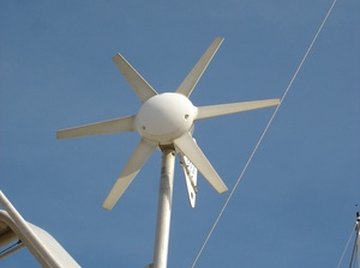
The mechanical energy is used by an AC generator to produce electricity. Sources such as water, wind or coal can be used to put in motion the rotors inside a generator. The most simple type of generator is put in motion by a hand crank. Bigger generators can be put in motion by wind or water turbines, compressed air or internal combustion engines. For example: If a river flows through or near a town, the mechanical energy source is the water flow.
Magnet
The magnet is a material that produces magnetic field. It has a north and a south pole and attracts ferromagnetic materials (metals that are attracted to the magnet and that can be magnetized such as iron, nickel or cobalt). Inside an AC generator, a magnet creates a magnetic field between the north and south pole. When the rotor moves between the north and south pole of the magnet, the electrons in the coil begin to flow.
Rotor
The rotor is a coil of wire that spins inside the magnetic field. The material used for the wire has to be a good conductor (made of atoms with loosely held electrons). When the wire is close to the south pole, electrons flow one way and when it is close to the north pole, electrons flow the other way. Because the wire spins from the north pole to the south pole of the magnet and back to the north pole and so on, the electrical current reverses direction constantly.
References
About the Author
Richard Dixon is an Aircraft Maintenance Technician. Dixon studied airplanes during high-school and 2 years of college. His passion for writing brought him into Demand Studio's team of dedicated people.
Photo Credits
eolic generator image by Gonçalo Carreira from Fotolia.com