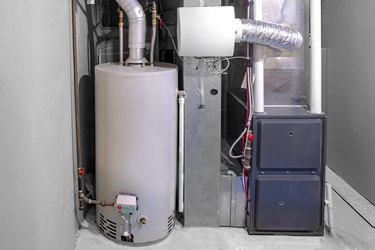
Gravity heating systems date to the late 19th century when coal was commonly used as a fuel for heating. Gravity heating systems are about simplicity, not efficiency, and they're rarely found in homes built after the 1950s.
Tip
Gravity heating systems use fuel-fired furnaces to warm surrounding air and ducts to force the air upward through a house or other structure. Vents in each room direct the warm air to heat the building.
Video of the Day
How Gravity Heating Works
Gravity furnaces are generally very large and are usually found in the basement of older houses or buildings. Ducts extend outward from the furnace and up into the structure in an octopuslike shape, so these furnaces are known as "octopus furnaces." Vents attached to the ducts direct the heat into rooms.
Video of the Day
These ducts aren't like the ducts from today's forced-air heating and cooling systems. There's no blower fan to force heated air into rooms. An octopus furnace depends on nature's ability to get warm air to rise above cooler air.
Gravity systems are quieter because of the lack of a blower, and dust isn't pushed around like with forced-air systems. They waste about 50 percent of the air they heat because that heat goes up the chimney and out of the house. Gravity systems also take much longer to heat indoor spaces than newer furnaces. So, while these furnaces are cheap to run, they require about twice as much oil or gas.
More on Gravity Furnaces
When gravity furnaces were introduced in the late 19th century, they were embraced because they introduced central heating into many homes and buildings that depended on wood for heat. Originally, they were meant to burn coal, although many were later retrofitted to burn oil, natural gas or propane gas. These furnaces have long lives because they have few moving parts, but they are also large, and the area around them must be kept clear to allow for free airflow.
Because coal was the original source for gravity furnaces, many are located near windows where coal was delivered. The coal was then loaded into a combustion chamber in the furnace, where it was burned to create the warm air to heat the house. By the middle of the 20th century, however, oil and gas became cheap, and most gravity furnaces were converted to run on these types of fuel.
Problems With Gravity Furnaces
An octopus furnace in your home is definitely a conversation piece. Some of them were artfully decorated. However, because about half of the warmed air goes out the chimney rather than into the house, you're wasting a lot of money on oil or gas that doesn't heat your house. In the long run, replacing the system may be cheaper. Modern forced-air systems, in contrast, are up to 95 percent efficient.
Even though gravity systems have ducts, these aren't the type of ducts that can distribute cooled air. The lack of a blower on the furnace means that there's no way to funnel cooled air from an air conditioning unit through the ducts.
Asbestos is another problem. Gravity heat systems typically used asbestos for insulation and fireproofing. It looks like a thick white coating around the furnace. If disturbed, asbestos fibers are known to cause cancer and should be removed by a qualified professional. The presence of asbestos can also decrease the value of your home. So, while gravity furnaces work and rarely break down, it's best to replace them with a more efficient heating system.