
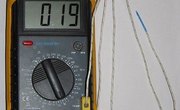
Thermocouples are temperature sensors that are made from two different metals. A voltage is generated when the metals are brought together to form a junction and there are temperature differences between them. Thermocouple circuits are governed by fundamental physical laws that affect their ability to take measurements.
The Seebeck Effect
A German physician turned physicist named Thomas Johann Seebeck took two different metals, with one at a higher temperature than the other, and made a series circuit by joining them together to form a junction. He found that by doing so he was able to generate an electromotive force (emf). Emfs are voltages. Seebeck found that the larger the temperature differences between the metals, the higher the generated voltage, regardless of their shapes. His discovery is called the Seebeck effect, and it is the basis of all thermocouples.
Background
Seebeck, H.G. Magnus, and A.C. Becquerel proposed the empirical rules of thermoelectric circuits. Lord Kelvin explained their thermodynamic basis, and W.F. Roesser compiled them into a set of three fundamental laws. They have all been verified experimentally.
The second law is sometimes broken up into three parts by modern day researchers, to give a total number of five, but Roesser’s are still the standard.
Law of Homogenous Materials
This was originally known as the Law of Homogeneous Metals. A homogeneous wire is one that is physically and chemically the same throughout. This law states that a thermocouple circuit that is made with a homogeneous wire cannot generate an emf, even if it is at different temperatures and thicknesses throughout. In other words, a thermocouple must be made from at least two different materials in order to generate a voltage. A change in the area of the cross section of a wire, or a change in the temperature in different places in the wire, will not produce a voltage.
Law of Intermediate Materials
This was originally known as the Law of Intermediate Metals. The sum of all of the emfs in a thermocouple circuit using two or more different metals is zero if the circuit is at the same temperature.
This law is interpreted to mean that the addition of different metals to a circuit will not affect the voltage the circuit creates. The added junctions are to be at the same temperature as the junctions in the circuit. For example, a third metal such as copper leads may be added to help take a measurement. This is why thermocouples may be used with digital multimeters or other electrical components. It is also why solder may be used to join metals to form thermocouples.
Law of Successive or Intermediate Temperatures
A thermocouple made from two different metals produces an emf, E1, when the metals are at different temperatures, T1 and T2, respectively. Suppose one of the metals has a temperature change to T3, but the other remains at T2. Then the emf created when the thermocouple is at temperatures T1 and T3 will be the summation of the first and second, so that Enew = E1 + E2.
This law allows a thermocouple that is calibrated with a reference temperature to be used with another reference temperature. It also allows extra wires with the same thermoelectric characteristics to be added to the circuit without affecting its total emf.
References
- Fundamentals of Temperature, Pressure, and Flow Measurement; Robert P. Benedict; 1984
- Manual on the Use of Thermocouples in Temperature Measurement; ATSM Committee E20 on Temperature Measurement; 1993
- Practical Temperature Measurement; Peter R. N. Childs; 2001
About the Author
Kim Lewis is a professional programmer and web developer. She has been a technical writer for more than 10 years and has written articles for businesses and the federal government. Lewis holds a Bachelor of Science, and occasionally teaches classes on how to program for the Internet.
Photo Credits
Jupiterimages/Comstock/Getty Images