
Hydrous Vs. Anhydrous

Hydrous and anhydrous are terms used in chemistry to describe substances that contain water and that are devoid of water, respectively. Chemical compounds that are hydrous are called hydrates. Compounds that are anhydrous are similarly called anhydrates. The water referred to is water of crystallization, an outdated term that is still used because of its self-explanatory nature. Hydrates are used in skin-care products like shampoo or lotion to infuse moisture, while anhydrates remove water to maintain intended dryness in paper products, among a plethora of others.

  1. Features

    • The composition of hydrates falls into two chemical categories, organic and inorganic. In organic chemistry, a hydrate results from the incorporation of water or its elements in another chemical compound. This usually alters the chemical composition of the initial compound and creates a new one with different properties.

    Features

    • Inorganic hydrates are salts that have a crystal-lattice shape, with a fixed ratio of water, which is essential to the crystal structure. These salts either attach to a metal center or form a crystal lattice with the metal complex. The water within crystallized salts is sometimes called water of crystallization because these compounds cannot crystallize in the absence of water.

    Types

    • An example of an organic hydrate is ethanol, a compound with the formula CH3---CH2---OH. Ethanol occurs when ethylene, CH2=CH2, is combined with H2O, one H bonding to the left side and the OH bonding to the right. Accordingly, an inorganic salt, Magnesium sulfate, MgSO4·7H4O, is a hydrate created with the addition of seven water molecules. Magnesium sulfate is actually Epsom salt.

    Features

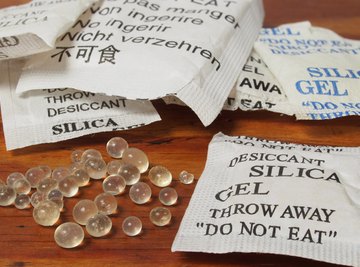
    • An anhydrous compound does not have water in its composition. It is usually created by the removal of water of crystallization, which can be done by applying heat or boiling. Other techniques for water removal include using molecular sieves, which do not allow absorption of molecules that exceed a certain size (e.g., water). Alkali bases like barium oxide are also used to attract molecules of water from a hydrous substance to render it anhydrous.

    Types

    • Sodium hydroxide, NaOH, is a hydrate that goes by the moniker "lye." When water is removed, sodium hydroxide becomes sodium oxide, or Na2O, which is used to make glass or ceramics. Epsom salt, MgSO4 ·7H2O, becomes an anhydrate when heated. In many cases anhydrates are created to perform reactions in which water would be damaging or produce unintended results.

    Function

    • Some anhydrates are used as drying agents because they absorb water so efficiently, earning them the nickname hygroscopic. Anhydrates can be used to remove water from other substances, but they can also be used to maintain moisture when they are a part of the chemical. In this form, they are also called humectants. Humectants are added for the sole purpose of retaining moisture in products, like food and cigarettes. Hygroscopic substances can also exist in reptiles and dry-climate animals whose survival depends on their ability to store water for long periods of time.

Related Searches:

References

  • Photo Credit "Free Happy Rainbow Water Droplet on Green Creative Commons" is Copyrighted by Flickr user: Pink Sherbet Photography (D. Sharon Pruitt) under the Creative Commons Attribution license.

Comments

You May Also Like

  • Uses of Ethanol Anhydrous

    Ethanol anhydrous or absolute alcohol has very low water content, often less than 1 percent. Ethanol anhydrous is obtained by removing most...

  • Uses for Anhydrous Salts

    Uses for Anhydrous Salts. If the thought of salt makes your mouth pucker and sends you running to the nearest tap for...

  • What Is a Hydrate in Chemistry?

    There are a number of phenomena that occur naturally in the world around us but that our science is only now beginning...

  • Examples of Anhydrous Salts

    Examples of Anhydrous Salts. To many of us, the word "salt" calls to mind a white crystal we add to potato chips...

  • What Is Anhydrous Methanol?

    Anhydrous methanol is methanol that is free of water. Methanol is hygroscopic, which means it absorbs moisture, including moisture from the air.

  • What Are Anhydrous Salts?

    You're likely familiar with several varieties of salt --- sea salt, bath salts, table salt --- but unless you're a chemist, anhydrous...

  • How to name simple organic compounds

    Name organic compounds like carbon compounds.

  • How to Handle Anhydrous Ammonia

    Anhydrous ammonia (NH3) gets its name due to its lack of water content--it is pure ammonia. Anhydrous ammonia is made up of...

  • Properties of Magnesium Chloride

    Magnesium Chloride is an inorganic salt, which has the chemical formula of MgCl2 and molecular weight 95.210 g/mol. Predominantly magnesium chloride exists...

  • What Is Anhydrous Diethyl Ether?

    Diethyl ether is more commonly called simply ethyl ether, or even more simply as just ether. If it has been carefully dried...

  • What are Anhydrous Hydrazine Uses?

    What are Anhydrous Hydrazine Uses?. Hydrazine (chemical formula N₂H₄) is a highly unstable and toxic chemical that donates electrons to other compounds....

  • The Properties of Anhydrous HCl

    Anhydrous (water-free) hydrogen chloride (HCl) is commonly used to make the water-based version of the same chemical - hydrochloric acid. Prepared commercially...

  • How to Make Anhydrous Milk Fat

    The term anhydrous means without water. Thus, anhydrous milk fat is milk fat without any water. Anhydrous milk fat is used in...

  • How to Calculate Hydrates

    Salts known as hydrates contain molecules of water incorporated into their crystal structures. If you heat a hydrated salt, you can cause...

  • Physical & Chemical Properties of Epsom Salt

    Physical & Chemical Properties of Epsom Salt. Epsom salt is also known as magnesium sulfate and bitter salt. There are three different...

  • Water Absorption of Plants

    Water is vital to every function of a plant, from growth and photosynthesis to hydration. All plants draw in water through various...

  • How to Make Anhydrous Ammonium

    Pure ammonia is sometimes referred to as anhydrous ammonia to distinguish it from aqueous solutions of ammonia. For example, household ammonia is...

  • How to Make Anhydrous

    Anhydrous is a state of a chemical indicating that it is free of water. The exact drying procedures vary from chemical to...

  • Properties of Boric Acid

    Boric acid, also known as Acidum Boricum, orthoboric acid and boracic acid, is a mild acid composed of a single boron, three...

Related Ads

Featured