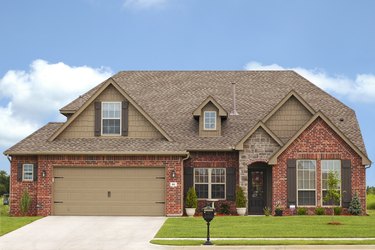
To know if a house utilizes masonry construction or brick veneer, you first need to understand what brick veneer is. It's not those adorable little brick slices you stick to your living room wall for a rustic look. Brick veneer is actually a single layer of full-sized bricks installed adjacent to a home's exterior wall. The inner wall bears the weight of the structure and not the brick. In this instance, the brick serves as a decorative element only. The homeowner may choose to add a brick veneer at any time after the home's construction.
Solid brick walls, on the other hand, consist of two layers of brick that get attached to each other during the building process. These walls are load-bearing and together form the home's exterior wall. There are some telltale signs that distinguish brick veneer from solid brick walls, including the pattern of the bricks and the way they are set around the windows. Solid brick walls are also more likely in older homes, but age alone is not conclusive.
Video of the Day
Video of the Day
Use Your Head(er)
To tell brick veneer apart from a structural brick wall, the first thing to do is look at the brick pattern. A veneer brick wall is just that; a single wall. A structural brick wall, however, is actually two brick walls built side-by-side. In order to attach these two individual walls to each other, bricklayers install header rows.
A header row is a layer of bricks laid perpendicular to the wall. Laying these bricks perpendicular bridges the gap between the walls, making the brick part of both. These bricks join the two walls to each other. Bricks are typically laid lengthwise, but bricklayers rotate header bricks 90 degrees and install then with the short end facing out. This change in the pattern is obvious if you know what to look for. While the pattern may vary, you'll usually see a header row every six rows.
Read 'Em and Weep
For obvious reasons, builders wrap the exterior walls of modern homes with waterproof materials. When adding brick veneer to the home, the brick is installed a few inches away from the exterior wall. This creates a space in which water and moisture can become trapped. To eliminate this problem, veneer installers drill weep holes along certain courses of brick. These holes allow air to circulate and let water run back out of the wall. Inspect the row of bricks just above the foundation and above windows. If there is a finger-sized hole drilled about every 32 inches, the house has brick veneer walls.
Window Shopping
The structure of a home's windows and doors will often reveal the building's construction. A lintel is a support structure installed above doors and windows in brick houses. Bricks are heavy, and windows and doors may not support the weight of the bricks above them without a little help. Solid brick walls usually have heavy stone or concrete lintels along with masonry arches.
Masonry arches are typically composed of two rows of end-on bricks in an arch over the window. You can also check the depth of windowsills and doorjambs. These features on a house with solid brick walls are very deep because the walls are two bricks thick. Windows will be set back about one brick length from the outside in a true brick wall. Those in a brick veneer house sit closer to the outside of the wall.