
The History of Goniometers

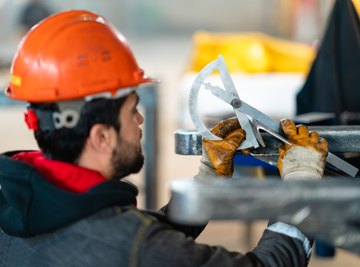
Goniometer is an instrument that measures angles and allows for objects to be rotated to a particular angular position. In 1669, Niels Stensen identified a very important characteristic of crystals which stated that the interplanar angles of the quartz crystals are constant. This characteristic was later determined to hold for all crystals (not just quartz), according to Virtual Museum of History of Mineralogy (mineralogy.be), and formalized into Steno's Law by Jean Baptist Louis de Rome de l'Isle in the mid-1700's.

  1. Early History

    • In 1780, Arnould Carrangeot developed a primitive instrument to measure angles between the faces of the crystals during the process of making models of crystals for l'Isle's collection. This instrument was the first of its kind and came to be known as a contact or an application goniometer. It consisted of two sections connected at the joint, according to mineralogy.be. The two sections, or limbs, were applied to adjacent crystal faces and the angle between them was measured. The approximate accuracy of this primitive goniometer was around 15 minutes.

    Optical Goniometer

    • In 1809, William Hyde Wollaston, an English chemist, invented the optical goniometer. This type of goniometer uses light reflection. The crystal is attached on a rotatable horizontal axis which is connected to a graduated (divided) circle, according to mineralogy.be. When the circle rotates, the second surface reflects the light ray in the same direction and the angle between the faces is determined by the difference between the reading of the graduated circle.

    Features

    • The optical goniometer has an accuracy of about 5 degrees. Soon after, a mirror was added to this type of goniometer in order to improve the positioning of the light reflection. This feature improved accuracy from 5 minutes to 1 minute.

    Vertical and Horizontal Goniometers

    • Vertical circle goniometers were introduced in 1843 by Eilhard Mitscherlich. This name comes from the fact that it is a high precision goniometer with a vertical circle and a telescope attached to its base, according to mineralogy.be. Horizontal circle goniometers were introduced earlier in 1839 by Jacques Babinet and they consisted of two attached telescopes. They had an accuracy of 30 seconds and were actually an improvement on the vertical goniometer.

    Modern Goniometers

    • A modern goniometer was first invented by W.H. Miller in 1874 and it consisted of two circles, instead of one. Two circles allowed for further measurements without the remounting of the crystal, according to mineralogy.be. Further developments included the three-circle instrument in the late 1800's, but these were used rarely because they were too expensive and complicated to adjust. In fact, all goniometers fell out of fashion soon after 1900 as a result of X-ray diffraction. Most goniometers are now considered collector's items and are typically only found in museums and special collections.

Related Searches:

References

  • Photo Credit "Rock Crystals" is Copyrighted by Flickr user: shaire productions (Sherrie Thai) under the Creative Commons Attribution license.

Comments

You May Also Like

  • Definition of a Goniometer

    A goniometer is a tool used to measure the angles formed by a liquid or solid. There are a number of types...

  • What Is a Goniometer Used For?

    A goniometer is a device used to measure angles or to allow an object to be rotated to a precise angular position....

  • The History of Crystallography

    Crystals are used by scientists in emergent technological fields such as holographic computers. Crystals are particularly valuable for their amplifying and absorbing...

  • Types of Goniometers

    A goniometer is an optical tool used to measure angles. Goniometers have a variety of uses in science and industry, and there...

  • What Is a Clinical Goniometer?

    A clinical goniometer is an instrument used by medical professional to determine the range of motion in a joint. It is used...

  • Goniometer Types

    Goniometers are devices made to measure angles. These instruments have found a wide range of applications in a variety of fields, including...

  • How to Measure Wrist Flexion Range of Motion

    The wrist joint moves in two separate planes, but even with semi-limited motion, the wrist serves many purposes to allow a human...

  • Jacques Charles Inventions

    Jacques Charles Inventions. Jacques Charles was a 17th-century French scientist with a number of inventions to his name. A few of these...

  • What Is a Goniometer?

    The goniometer is an instrument that has multiple applications in many fields of work. It helps aid in physical therapy and the...

  • Tools Used by a Mineralogist

    Our earth is made up of rocks, ores and minerals. Mineralogists go deep into the classification of minerals, studying their physical, chemical...

  • Types of Modern Communications Devices

    When cartoonist Chester Gould gave comic strip detective Dick Tracy a two-way wrist radio, he couldn't have known that he was foreseeing...

  • How to Make a Goniometer

    A goniometer measures range of motion in degrees. Physical therapists use goniometers to measure and track the range of motion of a...

  • Measuring Tools That Give the Angle

    A goniometer measures angles by way of a pivoting arm and an arc that gives angle measurements. It is especially useful in...

  • How to Test With a Goniometer

    A goniometer is a protractor with two, extended, moveable arms used to determine range of motion and measure the angles of joints....

  • How to Use a Goniometer

    A goniometer is used in the medical field to measure a joint's range of motion. It can be helpful in determining if...

  • Tools Mineralogists Use in Their Jobs

    Mineralogists study minerals to evaluate their structures and characteristics and to classify them. Mineralogists use different tools to collect and study samples...

  • Who Invented the Frisbee & How Did It Get Its Name?

    The Frisbee was developed in the 1930s and first manufactured under a different name in the 1940s by Fred Morrison . The...

  • How to Use a Goniometer for Hand Measurement

    Goniometry is a technique used to measure joint movement. A goniometer is a tool to measure the angle of movement. It consists...

  • The History of Phones

    The history of the telephone is long and detailed. It began with technology developed in the 1800s and has continued to evolve...

  • What Tool is Used to Measure Force?

    A dynamometer is used to calculate the force or power of a rotating object. There are several different types of dynamometers. They...

Related Ads

Featured