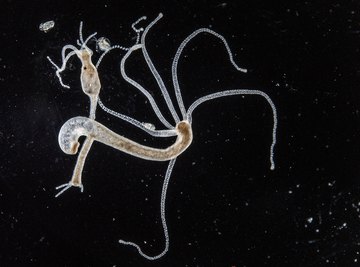
Have you seen photos of anemone-like colonies growing on the ocean floor? Ever met a jellyfish, online or in real life? These are creatures in the genus Obelia, which appear to be very different to the casual observer, but they are actually forms of the same animal at different stages in its very complex life cycle. It is difficult to imagine a more perfect example of strange animal species than those of Obelia.
TL;DR (Too Long; Didn't Read)
The Obelia life cycle begins as immobile polyp colonies that contain digestive hydranth and reproductive gonangium units. The gonangium reproduce asexually, releasing medusa by budding. The medusa, or jellyfish, swim freely and reproduce sexually, releasing eggs and sperm into the water. The resulting fertilized eggs develop into larvae, which attach to the ocean floor as new polyps.
Meet the Obelia
Obelia is a genus of invertebrate marine animals found throughout the planet’s oceans. These animals belong to the class Hydrozoa and phylum Cnidaria and include many species. Because Obelia start out as hydroid polyps, which are small, immobile animals with stalks and tentacles that resemble sea anemones, the common term for Obelia is sea fur. Perhaps the most interesting aspect of Obelia is that their reproduction strategy requires two distinct stages and two generations to complete.
Reproduction: Polyp Stage
The first stage of the Obelia life cycle is the polyp stage. All Obelia begin life as polyps connected to a solid surface like the ocean floor. Over time, the polyp grows until it forms a colony including hydranth and gonangium units. The hydranth portions of the colony contain mouths and stomachs and enable the colony to feed. The gonangium portions are the reproductive units in the colony. These members reproduce asexually by budding, releasing free-swimming medusa.
Reproduction: Medusa Stage
Medusa are jellyfish bearing the characteristic bell shape and tentacles. At this stage, the Obelia medusa swim freely and reproduce sexually by releasing either eggs or sperm into the water. Upon fertilization, the resultant zygote develops into a free-swimming larva (plural: larvae) covered in cilia, or tiny hairs. This larva uses the cilia to swim while developing. Eventually, the animal reaches the ocean floor and develops into a polyp. This begins a new life cycle.
Obelia are fascinating and strange animals who use both asexual and sexual reproduction as part of a single reproductive strategy. What's even more odd is that this reproductive strategy requires two generations (the polyp generation and the medusa generation) to complete one life cycle.
References
About the Author
Melissa Mayer is an eclectic science writer with experience in the fields of molecular biology, proteomics, genomics, microbiology, biobanking and food science. In the niche of science and medical writing, her work includes five years with Thermo Scientific (Accelerating Science blogs), SomaLogic, Mental Floss, the Society for Neuroscience and Healthline. She has also served as interim associate editor for a glossy trade magazine read by pathologists, Clinical Lab Products, and wrote a non-fiction YA book (Coping with Date Rape and Acquaintance Rape). She has two books forthcoming covering the neuroscience of mental health.