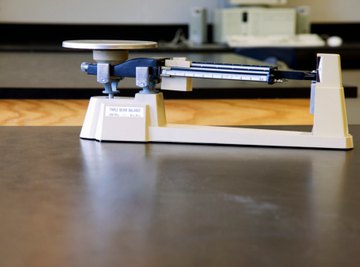

A triple beam balance provides greater accuracy than a spring scale in determining the mass of objects in grams. The balance can measure the mass of objects up to 610 grams in weight. Its accuracy is well-suited to most laboratory uses, finding the mass of any object with a margin of error of only .05 grams.
Basic Parts
While the designs of various triple beam balance models differ slightly, they have two basic components in common: the base and the pan. The base is a long metal platform which supports the rest of the apparatus. When moving the triple beam balance, place your hands on either side of the base for stability. The pan rests on top of the base and is a metal platform where the object being weighed is placed.
Adjustment Knob and Scale
The adjustment knob is located on the left hand side of the triple beam balance underneath the pan. The adjustment knob allows you to attain better accuracy when using the balance. The scale is located on the right hand side of the scale and is labeled with a zero. The scale lets you know when the beams are at their resting position of zero and indicates when the correct mass of the object has been found.
Beams and Riders
As implied by the its name, there are three different beams on the triple beam balance which function independently to asses the mass of an object. Located on each beam is a weighted rider which you slide along the beam to determine the object's mass. The first beam, located at the front, has a 10-gram scale and a .01-gram rider and is the lightest beam. The second beam, located in the middle, has a 500-gram scale and a 100-gram rider and is the heaviest beam. The third beam, located in the back, has a 100-gram scale and a 10-gram rider. When all three riders are positioned fully to the right, their weights add as 500 + 100 + 10 = 610 grams.
Using the Triple Beam Balance
Set up the balance by sliding all three riders to the right hand side of the apparatus. The pan should be empty and the beams should point to the zero on the scale, indicating the triple beam balance has been zeroed out. Place the object onto the pan and begin to measure the mass of the object by moving the riders along the beams until the scale reads zero. Once you have found the zero point, read the corresponding measurement on each of the riders and record the mass.
References
About the Author
Jessica Furgerson has been researching and writing for over four years. Her notable publications include freelance writing for Picket Fence Publications. After completing her Bachelor of Arts in 2010 at Western Kentucky University, Furgerson is now working on her Ph.D. in rhetoric and communication studies as well as advanced certification in women and gender studies.
Photo Credits
Jupiterimages/liquidlibrary/Getty Images