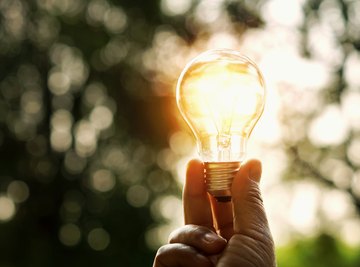
The British experimented with electric light beginning in 1835 by creating the arc lamp, but it would be another 45 years before Edison patented the first incandescent light bulb in 1880 after much trial and error. Along with electricity, the light bulb paved the way for cleaner and safer ways to use artificial light in darkened homes at night. In many ways, the light bulb opened up new opportunities and possibilities.
Parts of a Simple Light Bulb and How It Works
The simplest light bulb is the incandescent light bulb, which has three basic parts: the base, filament and glass bulb enclosure. The base connects the light bulb to the power source that provides electrical voltage. The base also holds the contact wires through which electricity must continuously flow to energize the filament. The filament is the part that heats up until it starts glowing to give off light.
An incandescent light bulb’s filament is made of tungsten, a periodic table metal with a very high melting point. This very high melting point allows tungsten to remain stable enough for the light bulb to continue working. A glass bulb encases the tungsten filament so that it does not catch anything on fire. The glass bulb either has a vacuum inside or an inert gas that prolongs the life of the filament so that the bulb can continue to light up.
Volts, Watts, and Lumens
Volt, watt and lumen are terms associated with light bulbs. Volts measure the force of electricity flowing through a wire. For example, a 6-volt battery is different from a 9-volt battery in that the larger battery forces more electricity through a wire than the smaller one.
Watts measure the amount of energy the light bulb uses per hour. A bulb with a higher wattage produces more light because of the increased power of electric current flowing through it. A 100-watt bulb uses up 100 watts of energy each hour. A lumen refers to the light bulb's measured brightness. A handy way of remembering watts and lumens is to keep in mind that watts measure energy use and lumens measure brightness output.
The Different Types of Light Bulbs
Nowadays, there are four major types of light bulbs: incandescent, fluorescent, light-emitting diode bulbs and outdoor solar lights. Edison patented the first incandescent light bulb, which refers to a bulb with a filament that heats up to emit light.
Fluorescent light bulbs offer more energy efficiency than incandescent light bulbs. Fluorescent bulbs have a coating of fluorescent material that emit light when energized by an electric current. Outdoor solar light bulbs contain solar cells that convert sunlight into electricity as a power source for the light. In LED bulbs, an electric current activates a microchip that powers up multiple tiny light-emitting diodes to produce light.
Light Bulb Safety
Handle light bulbs carefully because they can easily break, as its breakable parts are sharp enough to puncture skin. And some light bulbs contain chemicals -- like mercury in fluorescent bulbs -- that are highly toxic to humans. When fluorescent light bubs break, the mercury inside can escape as vapor or as fine powder-like droplets that can settle onto furniture. Whether inhaled or touched, this residue is toxic enough to cause mercury poisoning. As a result, the handling of light bulbs requires safety measures as well as proper clean-up and disposal by adults.
Light Bulb World Records
A number of interesting world records abound for light bulbs. For instance, the Livermore Centennial Light Bulb kept by the Livermore-Pleasanton Fire Department in Northern California is one of the world’s oldest, still operational light bulbs. It still works and has not been changed since it was first installed in1901. In June 2016, Canadian artist Serge Belo, created the largest light bulb image to date for an art installation in Kimpo City, South Korea. He created the light bulb's image using 18,072 light bulbs from the South Korean-based companies of LG Electronics and Envisible, Inc.
References
- NASA: Light Bulbs
- US Energy Information Administration: Science of Electricity Basics
- National Park Service: The Electric Light System
- The Franklin Institute: Edison's Light Bulb
- Federal Trade Commission: Shopping for Light Bulbs
- Guinness World Records: Longest-Burning Light Bulb
- Guinness World Records: Largest Light Bulb Image
About the Author
Mariecor Agravante earned a Bachelor of Science in biology from Gonzaga University and has completed graduate work in Organizational Leadership. She's been published on USA Today, Medium, Red Tricycle, and other online media venues.