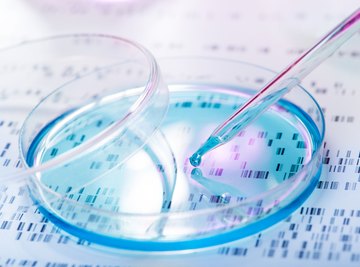

Electricity's role in biological processes is just as important as its role in technology, and it's harnessed to scientific use in a number of subtle and interesting ways. One technique that's widely used in biochemistry is electrophoresis, the use of an electrical current to manipulate protein molecules for a range of biomedical research, diagnostic and manufacturing purposes.
How the Process Works
Organic molecules often have a positive or a negative charge, which causes them to respond to an electric current. Molecules with a positive charge migrate toward the field's negative pole, and molecules with a negative charge migrate toward the positive pole. Molecules with a greater charge tend to move more quickly and travel farther while the charge is applied. However, they'll also be slowed by friction, which in turn is affected both by the size and shape of the molecule and by the medium used for the test. By controlling the electrical current and the friction provided by the test medium, researchers can create conditions that separate biomolecules efficiently, so they can be isolated and studied. It also permits researchers to identify the differences between molecules by observing how much they're influenced by the current. It's a useful tool with a range of experimental and biomedical applications, but a few are especially notable.
DNA Analysis
One leading use of electrophoresis is in the identification and study of DNA and DNA fragments. DNA is notable for the consistency of its negative charge, which means the electrical current applies roughly equal force to any portion of DNA. Under that pressure, larger and smaller fragments of DNA begin to separate because they'll are affected differently by friction from the test medium. The medium, usually an agarose gel or an acrylamide gel "freezes" the separated segments in place when the current is removed, which allows them to be examined at high resolutions. Staining agents such as ethidium bromide are often added to the gel to make it easier to see and interpret the results.
Protein and Antibody Interactions
Another common form of electrophoresis is immunoelectrophoresis, which analyzes the presence and behaviors of certain proteins. Many medical conditions, including multiple sclerosis, kidney disease and some cancers result in the creation of abnormal protein molecules. These can be detected by performing electrophoresis on urine or blood samples and watching for any variance from the normal quantities and types of protein. Immunoelectrophoresis can also be used to detect specific proteins called immunoglobulins, which act as antibodies. These are part of the body's immune system and attack foreign proteins, such as viruses or allergens. Analyzing these antibodies can help identify new therapies to treat those invaders and also provides insight into conditions such as allergies and autoimmune disorders, which can result from malfunctioning antibodies.
Testing Antibiotics
Electrophoresis plays a number of roles in the testing of antibiotics. One of the most common is testing the purity of an antibiotic. By applying electrophoresis to a solution containing the antibiotic in the form of a paper strip impregnated with the antibiotic or a capillary – a very thin tube – filled with the solution, researchers can differentiate between the antibiotic itself and any impurities. They can also determine how concentrated the antibiotic is, which is crucial for applying accurate dosages. Antibiotic research extends into the realm of genetic testing, identifying genes that might indicate resistance to specific antibiotics.
Testing Vaccines
As with antibiotics, electrophoresis is useful in both the creation and production of vaccines. The purpose of a vaccine is to help the body generate antibodies to a potentially dangerous pathogen, and electrophoresis is a useful method for detecting those antibodies. Researchers can use the technique to compare the effect of a vaccine or multiple versions of a vaccine across a large number of test subjects or other variables. Once a vaccine is in production, electrophoresis also provides a quick and effective way of testing production batches for consistency and purity.
References
- Pearson Education: Electrophoresis and DNA Analysis
- Nature Publishing Group: Electrophoresis and Antibiotic Analysis
- InTech: Gel-Electrophoresis and Its Applications; Pulimamidi Radindra Reddy, Nomula Raju
- MethodBook: Agarose Gel Electrophoresis (Basic Method)
- American Association for Clinical Chemistry: Lab Tests Online -- Protein Electrophoresis/Immunofixation Electrophoresis
- National Diagnostics: Immuno-Electrophoresis/Immuno-Diffusion
- Analytical Letters: The Use of Capillary Electrophoresis in Vaccines
- Journal of Chromatography A: Analysis of a Vaccine Purification Process by Capillary Electrophoresis; William M. Hurni, William J. Miller
About the Author
Fred Decker is a prolific freelance writer based in Atlantic Canada, where he grew from the kind of kid who read his encyclopedia for fun to the kind of adult who reads academic papers for fun. He was educated at Memorial University of Newfoundland and the Northern Alberta Institute of Technology. Aside from Sciencing, his articles on science and food science have appeared on major sites including eHow, Livestrong, TheNest, Leaf.TV and SFGate.com.