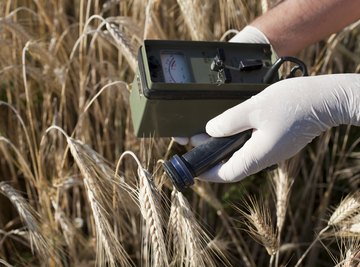
A Geiger counter detects ionizing radiation such as beta and gamma particles, and some models also detect alpha particles. The primary component of the Geiger counter is a tube filled with a gas that conducts electricity when struck by radiation. This allows the gas to complete an electrical circuit. This typically includes moving a needle and making an audible sound. Geiger counters can measure radiation in a variety of units, depending on the application.
The maximum recommended dosage of radiation is 5,000 mR/year for radiation workers in the United States and 200 mR/year for non-workers. Do not remain near strong radiation sources for prolonged periods. Severe exposure can result in sunburn-like skin lesions, hair loss and other serious consequences. Consult an expert if you have any questions about particular radioactive substances or radiation sources.
Set a small, known radioactive source, such as a “button” source about a foot from the open end of the Geiger counter’s detector tube.
Turn the Geiger counter on. If it is a battery-powered model, it may have a battery test function you can engage by turning a knob or pushing a button. Check the battery’s condition and replace it if it is weak.
Adjust the counter by turning the sensitivity knob until the needle points in the main part of the scale. If the radioactivity is strong, the counter will read off-scale; if too weak, it will display a number too small to read accurately. Digital models might have a sensitivity knob also, or they might adjust themselves automatically.
Turn the counter’s speaker on if it has one and listen to the clicks. Light radiation causes the counter to click every few seconds; this is completely normal and safe. Stronger radiation makes the counter click more rapidly. A steady, static-like buzz means the clicks occur faster than 20 times per second, indicating strong radiation. The counter may also have an “overload” light that signals the radiation is too strong for the scale to which you have it set; if it has this feature, adjust the sensitivity until the light turns off.
Familiarize yourself with the units the Geiger counter uses to measure radiation. For example, the REM, or Roentgen Equivalent in Man, is an older unit that measures the effect of radiation on living tissue. Vintage detectors measure in terms of millirems per hour. The more modern unit, the sievert, also measures radiation's effect on tissue, taking into account that organs such as the eyes are more sensitive to radiation than other parts of the body. The detector may have a switch that lets you choose between different units.
Read the visual readout, if there is one. Geiger counters that have meter readouts in CPM, that is, Counts or Clicks per Minute, mimic the audible clicks in visual form. CPM is the unit normally used to measure Alpha and Beta radiation.
Warnings
References
Warnings
- The maximum recommended dosage of radiation is 5,000 mR/year for radiation workers in the United States and 200 mR/year for non-workers. Do not remain near strong radiation sources for prolonged periods. Severe exposure can result in sunburn-like skin lesions, hair loss and other serious consequences. Consult an expert if you have any questions about particular radioactive substances or radiation sources.
About the Author
Allan Robinson has written numerous articles for various health and fitness sites. Robinson also has 15 years of experience as a software engineer and has extensive accreditation in software engineering. He holds a bachelor's degree with majors in biology and mathematics.
Photo Credits
Mihajlo Maricic/iStock/Getty Images