If your houseplant's leaves are turning yellow, it may have a sulfate deficiency. If the leaves are turning yellow but the veins in the leaves remain green, your plant may have a magnesium deficiency. Epsom salts, a natural source of both minerals, can help protect plants against such deficiencies, resulting in lusher foliage, increased chlorophyll production and a healthier, more beautiful houseplant. But as a safety precaution, keep the salts away from children and pets.
Video of the Day
Apply it to the Soil
Nourish your houseplant's roots by applying Epsom salts directly to the potting soil. If there are multiple houseplants that you wish to feed, save time by creating a big batch of Epsom salt solution. Mix 2 tablespoons of Epsom salt with a gallon of water, and water them with enough of the solution that moisture appears in the bottom drainage holes of each pot.
Video of the Day
Alternatively, measure the height of the houseplant in feet. You need a teaspoon of Epsom salt for each foot. Sprinkle the salt around the base of the plant. Water immediately to help dissolve the salt and carry it down to the houseplant's roots.
Spray it on the Houseplant's Leaves
The minerals in Epsom salt are taken up quickly through the houseplant's leaves when the salt is sprayed directly on the foliage as a foliar spray. In fact, foliar sprays may work faster than root applications. Dissolve a tablespoon of Epsom salt into a gallon of water. Pour the salty solution into a spray bottle and mist all exposed parts of the plant evenly. Use enough spray so that the leaves are dripping wet.
Examples for Specific Houseplants
Epsom salt has been used to improve the health and success of specific plant species that are sometimes grown indoors. For example, magnesium deficiencies are often cited as a reason for slow fruit growth on tomatoes (Lycopersicon esculentum), which grow in U.S. Department of Agriculture plant hardiness zones 2 through 10, and bell peppers (Capsicum annuum), which grow in zones 1 through 11. Spray the plants when they first produce flowers, and again when the tomatoes or peppers first appear, with a solution of 1 tablespoon of Epsom salt dissolved in a gallon of water.
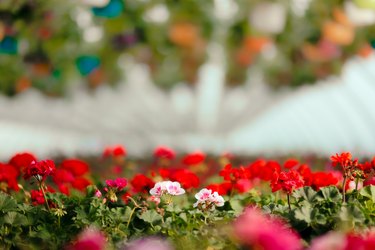
Roses (Rosa spp.), which have varieties that thrive in all U.S. plant hardiness zones, also respond well to Epsom salt. The salt may encourage the plants to grow darker green leaves. Use 1/2 cup of Epsom salt per plant, sprinkling it on the surface of the potting soil once in the spring before the houseplant's buds have opened and again in the fall.
Use it to Leach the Soil
Overfertilization can be just as harmful to your houseplants as underfertilization. Because your houseplant is grown in the limited space of a pot, fertilizer minerals can build up over time and create toxic concentrations that weaken the plant. Signs of overfertilization include browning of the houseplant's leaf tips, wilting of the leaves and white crust forming on the surface of the potting mix. The magnesium in Epsom salt helps draw excess fertilizer out of the soil.
Place your houseplant's pot in a sink or bathtub. Mix a teaspoon of salt in a gallon of water. Pour the entire gallon of salty solution into the pot, doing this slowly so the potting mix doesn't drain away. This is known as leaching and flushes out all excess fertilizer.
Myths and Safety Hazards
Epsom salt is not an all-purpose fertilizer. It will create healthier, greener, bushier houseplants but only if your houseplants are deficient in magnesium or sulfate. If your houseplants are not showing the yellowing symptoms of a deficiency, Epsom salts may not be beneficial. Finally, avoid ingesting the salt and keep it out of the reach of children and pets. While generally considered safe, Epsom salts may cause diarrhea if consumed.