
Things You'll Need
- Gloves
- Viral culture
- Broth
- 10 dilution tubes
- 10 culture tubes
- 10 Petri plates
- Boiling water
- Hot water bath
- Pipettes
- Tryptone agar
- Bacterial culture
- Incubator
- Calculator
Calculating titer for a virus is a complicated way of saying that a scientist is counting the number of viruses in a particular sample. To calculate virus titers, scientists infect plates of growing bacteria with viral solutions at varying concentrations and figure out the number of viruses in the original solution by counting the bacteria that have died due to the viral infection.
Serial Dilutions
Put on gloves, fill 10 culture tubes with 9 ml of broth and label them “10^-1,” “10^-2”, “10^-3,” and so on until “10^-10.” These tubes will be used for viral serial dilutions used to calculate phage titer. Since viruses can grow to incredibly high concentrations, you need to dilute them in order to count them effectively. Each tube represents a ten-fold dilution of the virus.
Take 1 ml of the virus culture that you want to calculate phage titer for and transfer it to the tube titled “10^-1” with a pipette. Mix the tube well. This is your first ten-fold dilution.
Take 1 ml of the mixed culture from your tube labeled “10^-1” and transfer it with a new pipette to the next tube, labeled “10^-2.” Mix this tube as well.
Continue this pattern to create a serial dilution series. You will end up with 9 tubes of 9 ml and 1 tube of 10 ml. The viral loads in your tubes will be diluted anywhere from 10 times (your first tube) or 100 times (your second tube) to ten billion times (your final tube).
Preparing Plates for Calculating Titer
Take 10 tubes of tryptone soft agar and 10 Petri plates and label them to correspond with your serial dilution tubes.
Loosen the caps so that they do not pop off in the heat and then place your agar tubes in a beaker of boiling water. This will melt the agar so that you can pour it into Petri plates.
Transfer your tubes to a hot water bath set at a minimum of 45 degrees Celsius. This will ensure that your agar does not solidify in the tubes before you have a chance to pour it into a Petri dish.
Add two drops of bacterial culture to your agar and mix it gently. These are the bacteria that will be killed, allowing you to count the number of virus particles in a particular solution.
Add 1 ml of each serial dilution to its corresponding agar tube while the tubes are still in the hot water bath. For example, 1 ml of your 10^-1 serial dilution should go into the agar tube labeled “10^-1.”
Mix each tube and then pour each tube into the Petri plate with the corresponding label. This will create a thin layer of agar that has been inoculated with bacteria and viruses in each plate. Let the plates grow overnight in an incubator.
Counting and Calculating Virus Titer
Be careful when working with viruses. Not all viruses are dangerous, but you should take precautions. Change your gloves often. Wipe up any spills immediately and disinfect the area.
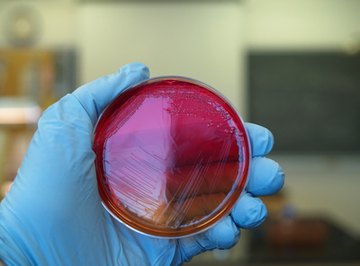
Take your plates out of the incubator and examine them. You should see cloudy areas throughout the plate where bacteria have grown, except for small clear spots called plaques. These plaques are patches of dead bacteria, and each plaque represents one virus.
Find a plate that has between 30 and 300 plaques and count the exact number of plaques on that plate.
Take the number of plaques in on your plate and multiply by 10. If you counted 157 plaques, you would get 1570.
Multiply the number that you got in the previous step by the inverse of the number on your dilution tube. For example, if the plate you selected was the 10^-5 plate, you would multiply 1570 by 10^5 to get 157000000. This final number is your phage titer, and represents the number of viruses per ml of your original culture.
Warnings
References
Warnings
- Be careful when working with viruses. Not all viruses are dangerous, but you should take precautions. Change your gloves often. Wipe up any spills immediately and disinfect the area.
About the Author
Ethan Schwartz has been a scientific and freelance writer for a year, writing scientific literature for "Gene Therapy" and articles on education, health and personal finance for eHow. Schwartz graduated in 2009 with a Bachelor of Science in biological sciences and will begin medical school in July 2010.
Photo Credits
Bacteria Colonies image by ggw from Fotolia.com