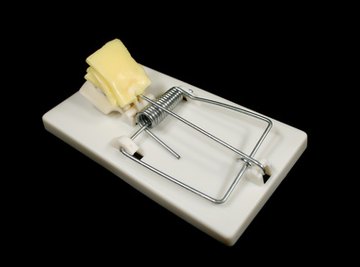
A mouse trap can be used for more than just catching a mouse; many science projects and craft projects involve mouse traps. Mouse traps are used in miniature projects that range from cars to catapults to fire extinguishers. Mouse trap projects can provide an interesting, educational experience for participants.
Cars
Mouse trap car projects are sometimes assigned to students as lessons in physics or in engineering and designing consumer products. Mouse trap car projects typically fall into one or more of these models: basic mouse trap car built with limited resources, basic mouse trap car using unlimited resources, speed mouse trap car made with or without a limit on resources, and distance mouse trap car with or without limit on resources.
The concept of a mouse trap car project is familiar to many students ranging from junior high to college. This project can provide a challenge to some of the most experienced industrial designers.
Basic materials are usually provided by the teacher or professor. The design and construction of a mouse trap car is followed by testing and collection of data.
Catapult
Miniature catapults can be built from mouse traps. This project involves using items that are found in most homes. The materials list comprises a traditional mouse trap, two sticks used for frozen confectiosn, one rubber band, duct tape, two erasers and a spoon. A mouse trap catapult is designed to hurl small projectiles, such as marshmallows or items of similar dimensions and weight.
Fire Extinquisher
Mouse trap projects can be hypothetical science experiments, such as attempting to blow out a candle using a mouse trap. One method is to have the mouse trap arm squeeze a small bellows to blow air on the flame. Another is to use the mouse trap to unwind a toy airplane propeller to produce enough wind to extinguish the candle.
Notepad Clip
A mouse trap can be used in craft projects. A mouse trap notepad clip can be made inexpensively with minimal materials. One design fcalls for an unused mousetrap, 12 or more inches of two colors of ribbon, a notepad, and a fake flower. This can be put together for less than $5.
References
About the Author
Paul Young started writing professionally in 2008. His writings have been published on various websites, including U.K. van insurance site, The Van Insurer, and its sister site, The Bike Insurer. Young focuses his writing on news articles about the motorcycle and commercial vehicle industries, environmental projects, information technology and money and finance. Young is involved in ministry.
Photo Credits
mousetrap image by Brett Mulcahy from Fotolia.com