
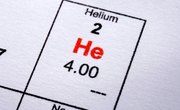
Helium is an element known as a noble gas. It is colorless and odorless, and it is prevalent throughout the universe. You may know about helium from helium balloons, which float. The element helium has many more uses than party balloons, however. It is also used in car airbags, high-tech equipment, medical devices and aircraft. Helium continues to be a major component of modern life, even though you cannot see it directly.
TL;DR (Too Long; Didn't Read)
Helium is the second most abundant element in the universe. While you cannot see or smell it, helium features in many everyday uses, in technology, medicine, and even in cars.
Why Is Helium Important to the World?
To understand helium's importance to the world, it helps to learn more about the element's properties. Additionally, it is crucial to learn about its history and how its supply issues feature into aspects of modern life.
Helium is an element that exists in gas form. Its atomic symbol is “He,” and its atomic number is 2 on the periodic table. Helium’s melting point is the lowest of all the elements, and its boiling point is -452 degrees Fahrenheit. Only helium can remain liquid even if its temperature is lowered. It will solidify only at extreme pressure. These properties make helium indispensable for certain newer technologies such as superconducting materials.
The element helium is second only to hydrogen in its abundance in the universe. Helium exists in every star, and it is most abundant in the very hottest stars. It is produced from nuclear-fusion reactions in stars. In fact, helium was discovered first while studying our own star, the sun. Helium is prevalent in the sun; it is an essential element and therefore important to the world.
Helium was not discovered until August 18, 1868. A French astrophysicist named Pierre Jules Cesar Janssen used a new astronomical device called a spectroscope to observe light wavelengths. The spectroscope displayed the spectra, or light wavelengths, as bands of color. While observing the eclipsed sun with a spectroscope, Janssen found a wavelength in the sun’s light that did not correspond to any other element yet found on Earth, in the form of a bright yellow line. Janssen realized he had discovered a new element. Another astronomer, the Englishman Norman Lockyer, also made this observation while viewing the sun. Both of them had observed the element helium, which Lockyer named after the Greek word for the sun. Eventually, in 1882, helium was in fact discovered on Earth, in the lava of Mount Vesuvius, when physicist Luigi Palmieri found the bright yellow spectra while he analyzed the lava. Later, William Ramsay conducted experiments that proved helium existed on Earth; he found that when element radium decayed, it produced helium. Per Teodor Cleve and Nils Abraham Langer would, in 1895, determent helium’s atomic weight.
Studying helium helps scientists better understand not only the Earth, but the other planets as well. In the solar system, scientists discovered helium in the atmosphere of the giant gas planets Jupiter and Saturn. On Saturn, a sort of helium rain, mixed with liquid hydrogen, falls into the atmosphere in an extreme environment of temperature and pressure. Scientists think that this helium “rain” falls to the core of the planet. Its unleashed gravitational potential energy may be what makes Saturn shine so brightly, a feature that has puzzled scientists for years.
Over time, scientists learned more about the properties of helium. The description of helium is that it is colorless and odorless, and lighter than air. This is why helium-filled balloons float, and helium is not very soluble in water. The inert qualities of the element feature often in the description of helium. Historically considered chemically inert, it tends not to react with other elements. Helium does not want to give up its two electrons; it remains stable with its electron shell. Because of this, helium is categorized as one of the noble gases, along with neon, argon, radon and other noble gases on the periodic table.
Recently, scientists discovered that helium is not completely inert, as once thought. Upon discovering crystals made from the elements helium and sodium, researchers found that helium can combine with other atoms while not sharing its electrons – in other words, it combines with other atoms but does not make chemical bonds in the process. Instead, it protects positively charged atoms from each other and counters the repellent force that normally pushes them apart. Under extreme pressure, such as might be at the Earth’s core, helium and hydrogen compress and form stable compounds. Scientists may uncover more fascinating aspects of the element helium, and whether it will still be possible to consider it truly inert, or if it can indeed form stable compounds in extreme environments.
In the atmosphere, helium is only concentrated in approximately 1 part in 200,000. It is not practical, cost effective or efficient to extract helium from the air, so that is not how people obtain helium. Instead, helium is produced from natural gas. Impurities such as water, sulfides and carbon dioxides must first be removed, and then the resulting crude helium, which still contains other elements like argon, neon, hydrogen and nitrogen, is purified at high pressures. This crude is then super-cooled. Argon and nitrogen are liquefied, and eventually nitrogen evaporates. Helium separates from neon, nitrogen and hydrogen. Additional filtering with activated charcoal removes other gases.
Helium can be found in some natural gas deposits around the world. It is not, however, in every natural gas deposit. In the United States, helium is extracted from wells in Kansas, Oklahoma and Texas. Texas alone houses the Federal Helium Reserve, the main supply for the U.S. This supply is, however, dwindling over time. A large deposit of helium also exists in Tanzania. There are now only 14 plants in the world that refine helium. Helium is also found in decaying radioactive minerals. It is naturally made from cosmic and x-ray bombardment of beryllium and lithium.
The shrinking supply of helium has become a major issue. The dependence upon helium in modern technology has increased, and the supply decreased as a result. Scientists are working to make helium production more efficient and sustainable. Novel methods such as recycling and re-liquefying helium might work on a small scale that can aid researchers. This can help reduce the cost of helium as its supply drops.
The discovery of helium has led to many great innovations. Eventually, many uses of helium would emerge. In modern life, helium’s importance is vast in the realms of technology, medicine and research.
What Is Helium Used For?
There are many uses of helium. Of course, it is used to fill party balloons that delight children and adults around the world. Helium replaced hydrogen in airships, after hydrogen was found to be highly reactive. Helium is used for medicine, scientific research, arc welding, refrigeration, gas for aircraft, coolant for nuclear reactors, cryogenic research and detecting gas leaks. It is used for its cooling properties because of its boiling point being close to absolute zero. This makes it attractive for use in superconductors. Helium is also used for pressurizing rockets and other spacecraft. It is also used as a heat-transfer agent.
In medicine, sometimes helium is used to aid patients with lung issues like obstructed airways, asthma and COPD. Helium enables better gas penetration to the distal alveoli in the lungs, so it is used for lung ventilation when medically necessary. Helium is also used for pulmonary function testing. Helium is also used in some laparoscopic surgeries instead of carbon monoxide. Helium is sometimes used as a label for imaging. Sometimes helium is used for open-heart surgery, mixed with oxygen and used as a mist for the lungs. Helium is also used to cool the superconducting magnets in MRI scanners. Radiation monitors also use helium.
Did you know helium is important for divers? Helium replaces nitrogen in diving gas mixtures, so that divers can go deeper under water without negative central nervous system effects. Without this mixture, divers could suffer from pressure effects with the condition called “the bends.”
There are numerous scientific uses of helium. The Large Hadron Collider uses helium for cooling purposes. Helium was used to discover the Higgs boson, a major breakthrough in physics. It is used in nuclear magnetic resonance spectrometers. Superconductors can only work if they are surrounded by the extreme cold of helium, and helium has been used in the space industry for cooling of satellite instruments and fuel coolant for spacecraft. Meteorologists use helium-filled weather balloons for weather observations. Scanning electron microscopes sometimes use helium for better image resolution.
Helium also plays an important role in vehicle safety. It is used to fill airbags if a vehicle crashes.
Helium is stored and shipped in liquid form, and it is extremely cold. Its lack of reactivity makes it ideal for protective environments. Do not ever handle helium directly. It is so incredibly cold that it can cause dangerous frostbite.
Where Is Helium Found in Everyday Life?
You can find helium used in everyday life in various forms. It is used as a lifting agent, in party balloons, in diving mixtures and in optical fibers. Welders use helium for welding arcs in construction. Physicians and surgeons use helium to help patients with lung and heart procedures. When you visit a grocery store, and your groceries are scanned, you are likely observing helium-neon lasers. If you ever see a blimp sailing overhead, you can be sure it is held aloft by helium. See if you can spot the use of helium in everyday life as you go about your day.
Is Helium an Explosive Gas?
Helium is not an explosive gas. It is classified as noncombustible, which means helium cannot burn. It is extremely cold in liquid form, so cold that it freezes other gases. However, if its container is exposed to heat, the container itself can burst. Liquefied helium can boil violently when placed in water, and this can lead to great pressure inside containers, increasing the risk that the containers could explode from the pressure. But on its own, helium will not explode.
What Are the Consequences of Inhaling Helium?
You may have heard the humorous sound of someone breathing in a bit of helium from a balloon. Breathing helium changes the pitch of the human voice, making it much higher, squeaky and cartoonish. The problem with doing this is that when you breathe in helium from a balloon, you are not breathing in air. Human bodies need to breathe air to function properly, and to get oxygen where it is needed in the brain and body. Even breathing in a tiny amount of helium can cause dizziness. But it can also cause a loss of consciousness and cause suffocation. Continued breathing of helium can even lead to death by anoxia, which means a starvation of oxygen from the body.
References
- Royal Society of Chemistry: Periodic Table: Helium
- PubChem: Helium
- Smithsonian Magazine: How Scientists Discovered Helium, the First Alien Element, 150 Years Ago
- Scientific American: A Noble Gas Surprise: Helium Can Form Weird Compounds
- Los Alamos National Laboratory Periodic Table of Elements: Helium
- National Geographic: We Discovered Helium 150 Years Ago. Are We Running Out?
- Physicists Find New Evidence for Helium ‘Rain’ on Saturn
About the Author
J. Dianne Dotson is a science writer with a degree in zoology/ecology and evolutionary biology. She spent nine years working in laboratory and clinical research. A lifelong writer, Dianne is also a content manager and science fiction and fantasy novelist. Dianne features science as well as writing topics on her website, jdiannedotson.com.