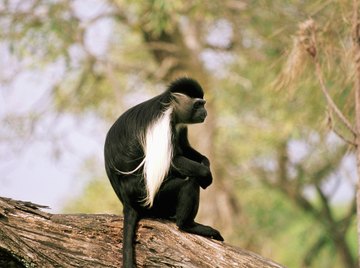

Over 130 species of monkeys live in far-flung locations around the globe. Zoologists have established two geographically distinct populations -- the Old World monkeys of Africa and Asia, such as macaques, baboons, and colobus monkeys, and the New World monkeys of the Western Hemisphere, such as spider monkeys, howler monkeys, and squirrel monkeys.
Most monkeys are arboreal, meaning that they live mainly in trees, while others are terrestrial and spend most of their time on the ground. Like all animals, monkeys have evolved in accordance with the unique demands of their environments.
Monkey adaptations, including the howler monkey, baboons, and various types of jungle monkey, allow them to live and survive in their particular environments.
Old World Versus New World Monkey Adaptations
New World monkeys are all arboreal, while Old World monkeys can be either arboreal or terrestrial. These two groups of animals display significant morphological differences.
Old World monkeys, such as macaques for example, have cheek pouches, so they can store food on the go and consume it later. New World monkeys don't need these, as living primarily in trees (like jungle monkeys, for example) minimizes the need to flee from predators. Also, Old World monkeys have ischial callosities, or hairless rump pads, which may represent adaptations for extended periods of sitting or lying on rough branches, rocks, and the like.
Arboreal and Jungle Monkey Adaptations
Although monkeys are formally classified as either arboreal or terrestrial, both types spend some of their time on the ground and some in trees.
Prehensile tails are tails that can grab and hold on to things. While all monkeys use their hands and feet to climb and navigate above the ground, only arboreal types have prehensile tails, which are ridged on the underside and very flexible. These tails are dexterous enough to grab things as small as a peanut, and strong enough so that monkeys can swing from branches using only their tails.
Arboreal monkeys also manifest more sentinel, or guarding, behavior when they do feed on the ground, a likely adaptation to being smaller and lighter -- which helps when spending a lot of time between tree branches -- and thus less formidable in physical combat. The Howler monkey has evolved a way to fend off predators when they do venture to the ground: a loud and intimidating scream (a "howl" so to speak).
Terrestrial Adaptations
Monkeys that conduct most of their monkey business on land show adaptations typical of land-dwellers, rather than tree-dwellers. While the smaller size of arboreal monkeys is an adaptation to living in trees, the aggressiveness of ground-dwelling moneys is related to their life in the more dangerous environment on the ground. Because terrestrial monkeys rely less on sentinels and more on traditional fighting to keep other species from laying claim to their food, they have evolved to be physically larger and stronger than New World monkeys.
Sexual Adaptations
Some Old World female monkeys have large, swollen patches of practically hairless skin in their genital regions, called sexual skins or sexual swellings. These become quite prominent at the peak of these monkeys' fertility -- that is, when they are in estrus. Under the provocation of hormonal changes that also lead to ovulation, these areas become swollen with fluids and turn bright pink or red, and emit odors that male monkeys find exciting.
In some species, size matters; in olive baboons, for example, the males find the females with the largest sexual skins the most attractive in a community. As a result, these females usually have more offspring, and so they are more likely to pass along the genes for super-prominent skins to the next generation.
References
About the Author
Michael Crystal earned a Bachelor of Science in biology at Case Western Reserve University, where he was a varsity distance runner, and is a USA Track and Field-certified coach. Formerly the editor of his running club's newsletter, he has been published in "Trail Runner Magazine" and "Men's Health." He is pursuing a medical degree.
Photo Credits
Medioimages/Photodisc/Photodisc/Getty Images