
Nucleic Acid Functions

Nucleic Acid Functions thumbnail
Nucleic Acid Functions

The human body is made up of millions of cells that work to maintain the body's overall system and function. Each cell, in turn, has its own set of processes designed to carry out necessary cell functions. Nucleic acid plays an essential role in coordinating and maintaining individual cell processes throughout the body.

  1. Identification

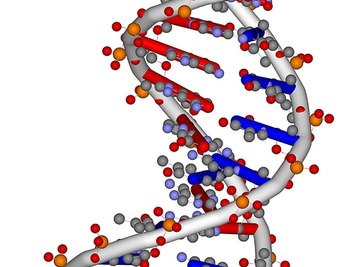
    • Nucleic acid is the chemical compounds that make up a cell's genetic information. Deoxribonucleic acid (DNA) and ribonucleic acid (RNA) are the most common forms. The DNA double-helix strands and RNA strands are connected to structural units, or molecules called nucleotides. The sequence in which nucleotides are positioned on a DNA/RNA strand determines what code a nucleic acid holds. Each of these structural units contains a sugar, a phosphate group and a base material. Both DNA and RNA combine with protein materials to carry out cell division and cell repair processes.

    Function

    • Cell repair and cell reproduction processes are encoded within the structural make-up of nucleic acids. DNA strands are responsible for maintaining the cell's genetic information, while RNA strands work to coordinate cell processes according to these genetic instructions. RNA molecules are also involved in manufacturing the proteins needed by the cell for normal function. In order to coordinate all of these processes, the RNA nucleic acids reside in the cytoplasm that surrounds the nucleus, while DNA strands are located in the nucleus of the cell.

    Replication

    • The process of cell division requires the DNA nucleic acid to replicate itself in order to reproduce daughter cells. Daughter cells are identical in structure to the parent cell. This process requires the parent cell to split, or break the bonds which connect the strands. Once broken, each strand can serve as a template, or guideline for the making of a new set of strands. This process is called semi-conservative replication. Once completed, an identical DNA helix is formed.

    Transcription

    • Transcription is the process in which DNA nucleic acids transfer the cell's genetic information into RNA materials. In essence, each DNA strand manufactures a corresponding RNA strand. Three types of RNA are manufactured within this process. Messenger RNAs (mRNA) are designed to carry the genetic information received from the DNA strands. Ribosomal RNAs (rRNA) reside in the cell's cytoplasm, and are responsible for decoding, or translating the genetic instructions into cell processes. Transfer RNAs (tRNA) are responsible for gathering whatever amino acids are needed for protein synthesis.

    Translation

    • Translation is the process in which RNA molecules create the proteins needed to sustain necessary cell functions. This is accomplished by converting the genetic code contained in the messenger RNAs into amino acid strings, which is what make protein molecules. This conversion process takes place within the ribosomes, which are located in the cell's cytoplasm. The proteins manufactured by ribosomes are then used to manufacture cell enzymes, the chemicals responsible for regulating cell processes.

Related Searches:

References

Resources

  • Photo Credit Ghutchis/flickr.com -- a DNA helix

Comments

You May Also Like

  • Structure & Function of Nucleic Acids

    The two natural types of nucleic acids are deoxyribonucleic acid (DNA) and ribonucleic acid (RNA). In animals, DNA forms a double helix...

  • Use of Nucleic Acid

    According to the History of Nucleic Acids, nucleic acids (the main players in the protein synthesis in living organisms) were first discovered...

  • Nucleic Acid Facts

    Nucleic acids hold the basic building blocks for life. Deoxyribonucleic acid (DNA) and ribonucleic acid (RNA) are found in all cells. DNA...

  • What Are Examples of Nucleic Acids?

    What Are Examples of Nucleic Acids?. Johann Friedrich Miescher discovered DNA in the nineteenth century. He called it nuclein because he found...

  • Definition of Nucleic Acids

    Nucleic acids are some of the most significant molecules found in living organisms. Their role is to store and transmit genetic information...

  • Structure of Nucleic Acids

    Comments. You May Also Like. Structure & Function of Nucleic Acids. The two natural types of nucleic acids are deoxyribonucleic acid (DNA)...

  • Role of Nucleic Acids

    Nucleic acids, more commonly known as DNA and RNA, are the genetic information banks of the cell. They are involved in repair...

  • Biological Importance of Nucleic Acids

    Nucleic acids are large macromolecules composed of smaller nucleotides. These nucleotides are made up of two backbones that alternate between sugar groups...

  • Use of Nucleic Acids

    The two main types of nucleic acid are deoxyribonucleic acid (DNA) and ribonucleic acid (RNA). They store and convey the genetic code...

  • What Is the Importance of Nucleic Acids?

    Nucleic acids are vital for cell functioning, and therefore for life. There are two types of nucleic acids, DNA and RNA. Together,...

  • Uses of Nucleic Acid

    Essential bodily functions such as growth, repair and reproduction all rely on nucleic acid for direction and support. Nucleic acid is in...

  • Nucleic Acids in Human Body Systems

    The nucleic acids most prominent within the human body system are DNA and RNA. These materials are responsible for maintaining and reproducing...

  • Sources of Nucleic Acid

    Nucleic acid---and ribonucleic acid (abbreviated RNA) in particular---is an important part of your body's chemical makeup. RNA has regulatory and immune-enhancing ...

  • Components of Nucleic Acids

    Components of Nucleic Acids. Nucleic acids are often called "the building blocks of life." It's an apt title considering that DNA contains...

  • The Differences Between Nucleic Acid and a Nucleotide

    A chemical coding system is used universally by every living organism on Earth. The system is similar among the different species, but...

  • Nucleic Acid Metabolism

    The human body's most basic metabolism processes take place at the cellular level. Nucleic acids hold the fundamental blueprints on how these...

  • How Does the Tissue & Cell Function Relate to the Structure of the Pancreas?

    The tissues of the pancreas perform two distinct tasks: digestion and regulation of blood sugar levels.The pancreas is an oval-shaped organ situated...

  • Characteristics of Nucleic Acids

    Characteristics of Nucleic Acids. Nucleic acid, so named because it is found in a cell's nucleus, is a catch-all term for DNA...

Related Ads

Featured