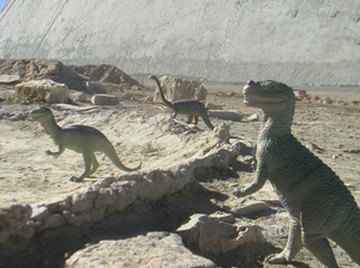

Trace fossils show the evidence of how an animal or plant interacted with its environment. They differ from body fossils--which are the preserved remains of the physical parts of an organism, such as bones and teeth. For example, dinosaur footprints are classed as trace fossils. Trace fossils can be useful in paleontology--the study of prehistoric remains. They offer clues as to how an animal behaved.
Types of Trace Fossil
Trace fossils can take a number of forms. One of the most common and recognizable are preserved footprints. However, trace fossils can also include anything that displays a creature's activity, such as burrows made by tunneling animals; the nests of dinosaurs and birds, including any fossilized egg shells; animal droppings; bite marks; holes left by root bulbs, and any trails lefts by marine creatures.
Formation
Trace fossils generally formed in soft substrates, according to the Ottawa-Carleton Geoscience Centre. For example, when an animal such as a dinosaur walked on soft mud it left an imprint. Like our footprints on sand or soil, most dinosaur prints were then washed away forever. However, some footprints were preserved as the mud dried and layers of sedimentary rock covered the print over millions of years. Burrows may be preserved in sandstone or similar rock formations.
Value for Science
Trace fossils can offer paleontologists and other scientists valuable information about extinct lifeforms that body fossils cannot. For example, a trace fossil of a dinosaur nest can give clues about how the young of that species were raised. Scat fossils may offer evidence as to what a particular animal ate when it was alive. Scientists may be able to infer the size and weight of an animal from a footprint. If there are a group of footprints together in one location, it may suggest that the animals lived and moved in a herd, according to the University of California Museum of Paleontology. In general, trace fossils may help scientists to get a larger picture of how an animal lived and not just how it looked.
Relationship to Body Fossils
Paleontologists look for both trace and body fossils to get a more complete picture about prehistoric life. The presence of some types of trace fossil often indicate that body fossils could be nearby. For example, fossilized burrows may contain fossil skin or skeletons from the creatures that lived there. Bite marks on a fossilized dinosaur bone may show scientists that a creature was preyed upon by another dinosaur. The marks themselves may help them deduce which dinosaur did the biting--such as a tyrannosaurus rex or a velociraptor.
Example of a Trace Fossil
In 2003 the National Geographic reported that German paleontologists had found a 17 million-year-old rodent burrow containing 1,800 fossilized nuts. The nuts were stored in small pockets at the end of several branches of a large network of tunnels. The find gave scientists an insight into the behavior of an extinct mammal, including its food source. In this case the nuts came from chinkapin trees, and the animals are believed to have been early types of hamster.
References
About the Author
Based near London, U.K., Peter Mitchell has been a journalist and copywriter for over eight years. Credits include stories for "The Guardian" and the BBC. Mitchell is an experienced player and coach for basketball and soccer teams, and has written articles on nutrition, health and fitness. He has a First Class Bachelor of Arts (Hons.) from Bristol University.
Photo Credits
dinosaure image by benjamin cabassot from Fotolia.com