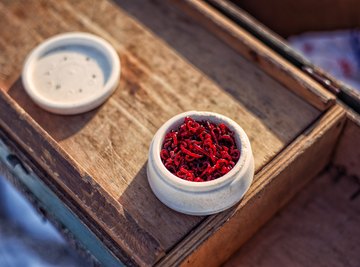
They're long and vivid red, which is how they earned their name, but there's a lot more to be said about Glycera Dibranchiata, the formal name science has given the bloodworm. Indigenous to mud flats along coastal areas around the U.S. and Mexico, bloodworms are very hardy creatures known for their ability to thrive in very little oxygen thanks to their high tolerance for all sorts of salinity environments. The good news is that Mother Nature will do most of the work of propagating these slithering creatures for you. The not-so-good news is that you will need to become a matchmaker by pairing larvae from a stagnant pond with vegetation in a contained environment that is known to be really smelly once it's established. There's more good news, however. Once they've morphed from larvae to worms, you'll have no problem catching them, as these creatures are really bad swimmers.
- Large, sturdy container to hold cultures
- Water supply
- Small aquatic pump
- Larvae
- Glass jar(s)
- Leaves and soil (no grass)
- Small section of screening material (optional)
Numerous incidents associating bloodworms with allergic reactions have been reported by fisherman and scientists, so if you're highly sensitive to allergens you may experience a reaction to touching these worms. Alternately, even if you're not allergic to the worms, they are known to inflict painful bites, so always be careful when handling them.
Fill the container you've selected with water and then sink the aquatic pump into the tank. If the pump you're installing has suckers, attach them to the side of the container to keep it from moving around too much.
Place a small piece of screening around the pump so it acts as an additional filter to keep as much debris away from the pump as possible. The screen won't trap everything, but it will cut down on the number of times you'll have to unclog the pump filter.
Switch on the pump and let the water circulate to ascertain the speed at which the pump is pushing water. If the water moves too briskly, the organic material won't decompose well and the environment won't be hospitable for the larvae. Turn down the pump speed or replace the pump if you notice a current rippling across the water.
Find a pond that has been hospitable to mating flies to launch your bloodworm farm. Adult flies will only mate in the air but you won't have a problem finding the larvae they've dropped over the water. Concentrations of larvae look like a thick dust sitting on the water's surface. Scoop up plenty of this matter from the pond, place it into a glass jar and bring it back to the tank.
Gather up vegetation, soil and other organic matter. Dry, old leaves work really well. If you're concerned about insects and bugs, boil the leaves before you pour them into the tank. Avoid adding green or dried grass to the mix to keep flies and smell down. Place the bloodworm larvae into the tank. They will float to the surface in a short while. Place the tank beside an electrical outlet to keep the pump moving, but put some space between you and the tank because the smell will get really bad as the vegetation and larvae set up housekeeping.
Let the tank and its occupants honeymoon undisturbed with just the gentle pump movement in play for a couple of weeks. Bloodworm experts recommend plenty of sun to help with decomposition of organic matter and maturation of the larvae. You should see results in about two weeks. Bloodworms can live for years, but your worm farm will thrive if you add a constant supply of larvae to the tank to keep things moving once you've got the hang of the process.
Clean the filter regularly, but otherwise, allow the vegetation to stay stagnant. Use your homegrown bloodworms as fishing bait or freeze-dry them if you want to store them for future use.
Things You'll Need
Warnings
References
Warnings
- Numerous incidents associating bloodworms with allergic reactions have been reported by fisherman and scientists, so if you’re highly sensitive to allergens you may experience a reaction to touching these worms. Alternately, even if you’re not allergic to the worms, they are known to inflict painful bites, so always be careful when handling them.
About the Author
Based in Chicago, Gail Cohen has been a professional writer for more than 30 years. She has authored and co-authored 14 books and penned hundreds of articles in consumer and trade publications, including the Illinois-based "Daily Herald" newspaper. Her newest book, "The Christmas Quilt," was published in December 2011.