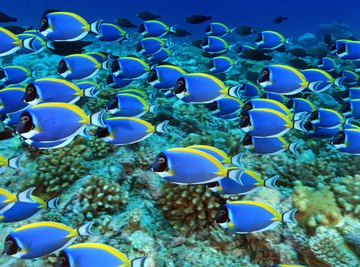

The ocean ecosystem covers most of the earth's surface and is home to millions of plants and animals. Understanding the ocean ecosystem is important for children, as it affects everyone. It influences the weather all over the earth and produces about 70 percent of the oxygen we breathe.
How Big Is the Ocean Ecosystem?
While there are five different named oceans – the Arctic, Atlantic, Indian, Pacific and Southern oceans – they are all actually the same body of water. The oceans cover about 70 percent of the earth’s surface and have an average depth of 2.4 miles. The deepest part of the ocean, the Mariana Trench, is about 36,200 feet deep, which is deeper than Mt. Everest is tall. The ocean ecosystem includes everything in the oceans, as well as the saltwater bays, seas and inlets, the shorelines and salt marshes. It is home to the smallest organisms like plankton and bacteria, as well as the world's largest living structure – the Great Barrier Reef, which can even be seen from the moon.
Ocean Ecosystem Zones
The ocean is divided up into three zones, or layers, based on how much sunlight they receive. The top layer is called the euphotic zone, which receives lots of sunlight. It starts at the ocean's surface and goes down to about 230 feet on average. The second layer is the disphotic zone, which receives some sunlight, but not enough for plants to survive. The third layer is the aphotic zone, which gets no light at all. Not only is the aphotic zone completely dark, it is extremely cold and few marine animals can survive here.
Ocean Plant Life
Marine plants live in the euphotic zone of the ocean, because they need sunlight to create food through photosynthesis. These plants include seaweeds, marine algae and sea grasses. Mangrove trees, which live on muddy tropical shores, are also part of the ocean ecosystem. These plants absorb carbon dioxide and turn it into oxygen through photosynthesis. Kelp is just one type of marine algae you might recognize. It provides food and shelter to ocean animals and is even used by humans in things like ice cream and toothpaste.
Phytoplankton is another important plant found in the ocean. This is the food for many ocean creatures, from the largest whales to the smallest fish. There is so much phytoplankton in the ocean, it produces about half of the oxygen in the world.
Ocean Animals
The ocean contains a large variety of animal life, including fish, mollusks, dolphins, seals, walruses, whales, crustaceans, bacteria, sea anemones and many others. Most marine animals live in the top two ocean zones, where they have access to plants and other ocean animals to eat. The ocean is home to the largest animal species on earth – the blue whale. The blue whale can grow to over 100 feet long.
The deep ocean does include life too, including some of the strangest animals on earth. One such creature is the anglerfish. It creates its own light on a tiny lure that it uses to attract other animals. When its prey gets closes enough, the anglerfish gobbles it up.
References
About the Author
A published author and professional speaker, David Weedmark was formerly a computer science instructor at Algonquin College. He has a keen interest in science and technology and works as a technology consultant for small businesses and non-governmental organizations. A science fiction writer, David has also has written hundreds of articles on science and technology for newspapers, magazines and websites including Samsung, About.com and ItStillWorks.com