
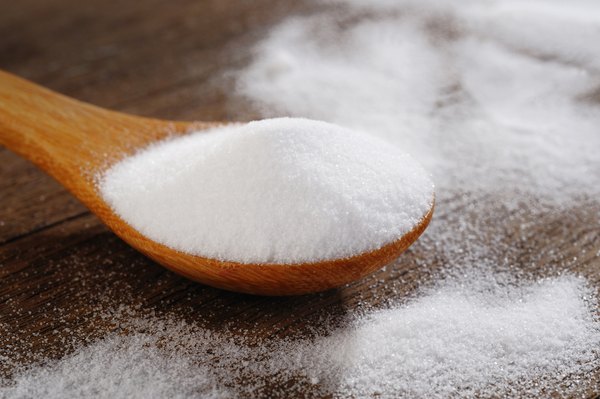
A common staple in many homes and science classrooms, sodium bicarbonate is more commonly known by the name baking soda. Like all types of matter, sodium bicarbonate has definitive physical and chemical properties that can be observed or quantified. These properties include baking soda's appearance and chemical behavior.
Molecular Composition
Sodium bicarbonate is a mixture of carbon, sodium, hydrogen and oxygen. One molecule contains one carbon atom, one sodium atom, one hydrogen atom and three oxygen atoms for a molecular formula of NaHCO3 or CHNaO3. Based on molecular weights, sodium bicarbonate is composed of 57.1 percent sodium, 27.4 percent oxygen, 14.3 percent carbon and 1.2 percent hydrogen.
Physical Properties Observed
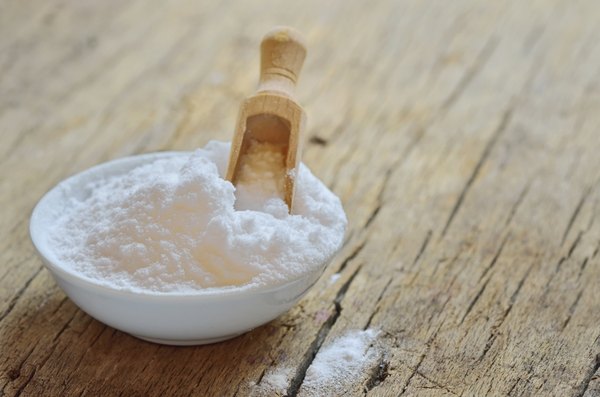
The physical properties of a substance are characteristics of that can be observed without changing the composition or identity of the substance. Observations about the appearance of sodium bicarbonate such as color, odor, taste and state of matter are all physical properties. Sodium bicarbonate is a white, crystalline powder that sometimes forms lumps. It is odorless and has a bitter, salty taste. At room temperature, it is a solid. Solubility, or the ability of a substance to dissolve in water, is also a physical property. Sodium bicarbonate is soluble in water and can be separated from water through evaporation.

Chemical Properties Ascertained
Chemical properties describe observations of a substance based on the ability of the substance to change its chemical composition. Decomposition and pH are two common chemical properties of sodium bicarbonate. The concentration of hydrogen ions (H+) in a solution is a chemical property referred to as pH. The pH scale ranges from 0 to 14. A pH less than 7 indicates an acid, a value of 7 is neutral and a value greater than 7 is considered alkaline. A 1 percent molar solution of baking soda in water at room temperature has a pH of 8.3. This number indicates that baking soda is alkaline, which accounts for its bitter taste. Decomposition is the process using heat to break down a substance into simpler components that are different from the original substance. When heated to a temperature greater than 50 degrees C (122 degrees F), sodium bicarbonate decomposes, or splits apart to form mostly carbon dioxide (CO2) and water (H2O) with trace amounts of sodium carbonate (NaCO3). Decomposition is a chemical change.

Sodium Bicarbonate Uses
Some of the physical and chemical properties of sodium bicarbonate have useful applications. Baking soda’s alkalinity causes it to react with acids. This property makes sodium bicarbonate useful for baking, cleaning and deodorizing. Many bad odors are caused by acids, and baking soda neutralizes these odors when it reacts with them. The gas released during an acid-base reaction between baking soda and an acid such as cream of tartar, lemon juice or lactic acid in buttermilk causes baked goods to rise. The abrasive texture of baking soda crystals is useful for cleaning dirt and stains from a variety of surfaces, including teeth.


References
About the Author
A.P. Mentzer graduated from Rutgers University with degrees in Anthropology and Biological Sciences. She worked as a researcher and analyst in the biotech industry and a science editor for an educational publishing company prior to her career as a freelance writer and editor. Alissa enjoys writing about life science and medical topics, as well as science activities for children