
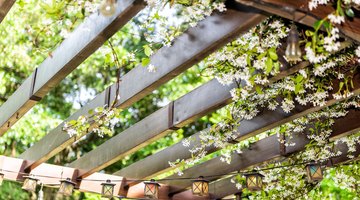

A brush arbor is a rough, open-sided shelter constructed of vertical poles driven into the ground with additional long poles laid across the top as support for a roof of brush, cut branches or hay. Appearing in the 1700's and early 1800's, brush arbors were used by some churches to protect worshipers from the weather during lengthy revival meetings.
Protracted Meetings
Brush arbor revivals began in the late 1700's and were held regularly through the mid-1900's. These "protracted meetings" could last for days or even weeks, with many people traveling for miles to attend and staying to camp on the grounds.
Circuit-riding Preachers
An itinerant minister or a preacher who rode circuit through rural communities would send word in advance of his expected arrival and the congregation would erect a brush arbor to house the revival meeting, usually at a crossroads in a well-traveled area.
When the Crowds Grew
Leafy branches overlaid the pole structure, blocking the hot summer sun and most rainfall. A pulpit was set up in the center front. When the crowds overwhelmed the space under the arbor, extensions could be built to accommodate them.
Black Congregations and Brush Arbors
Brush arbors were also used for revivals and worship services by African-American congregations before and after the end of slavery in the United States.
Brush Arbor Diary
An 1834 diary kept by Elizabeth Cummings gives details of a brush arbor meeting from the perspective of a young girl whose parents helped Brother Daniel Truelove, a Baptist circuit rider, erect a brush arbor for his revival.
Related Articles



Writer Bio
H.J. Hill is a freelance writer based in Texas. A lawyer by training, she has been published in several legal venues and received her Juris Doctor degree from Southern Methodist University. Her experience includes 20 years as a homeschooling parent.